Same 3.3V Output.
25 Years Apart in Technology.
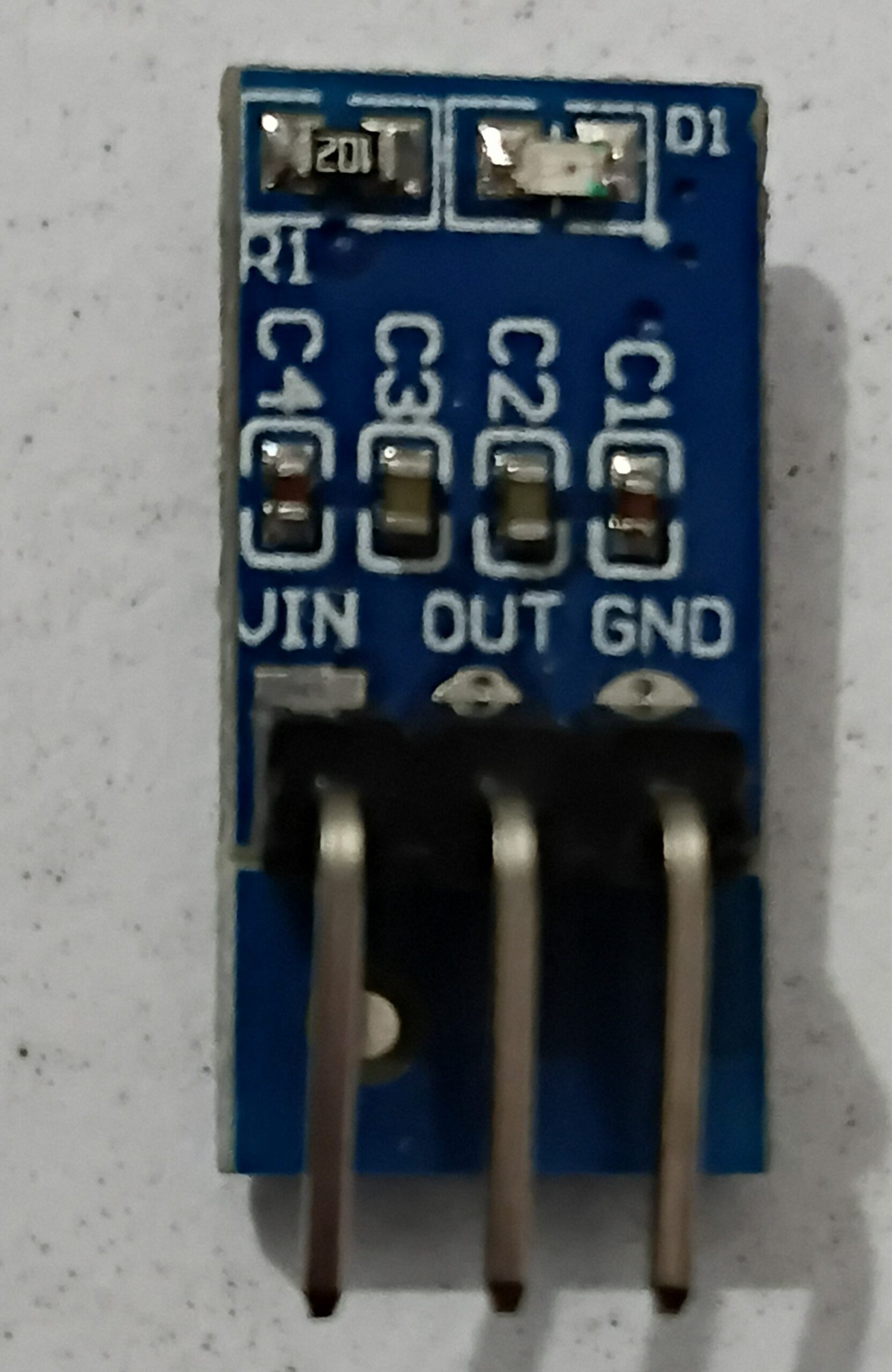
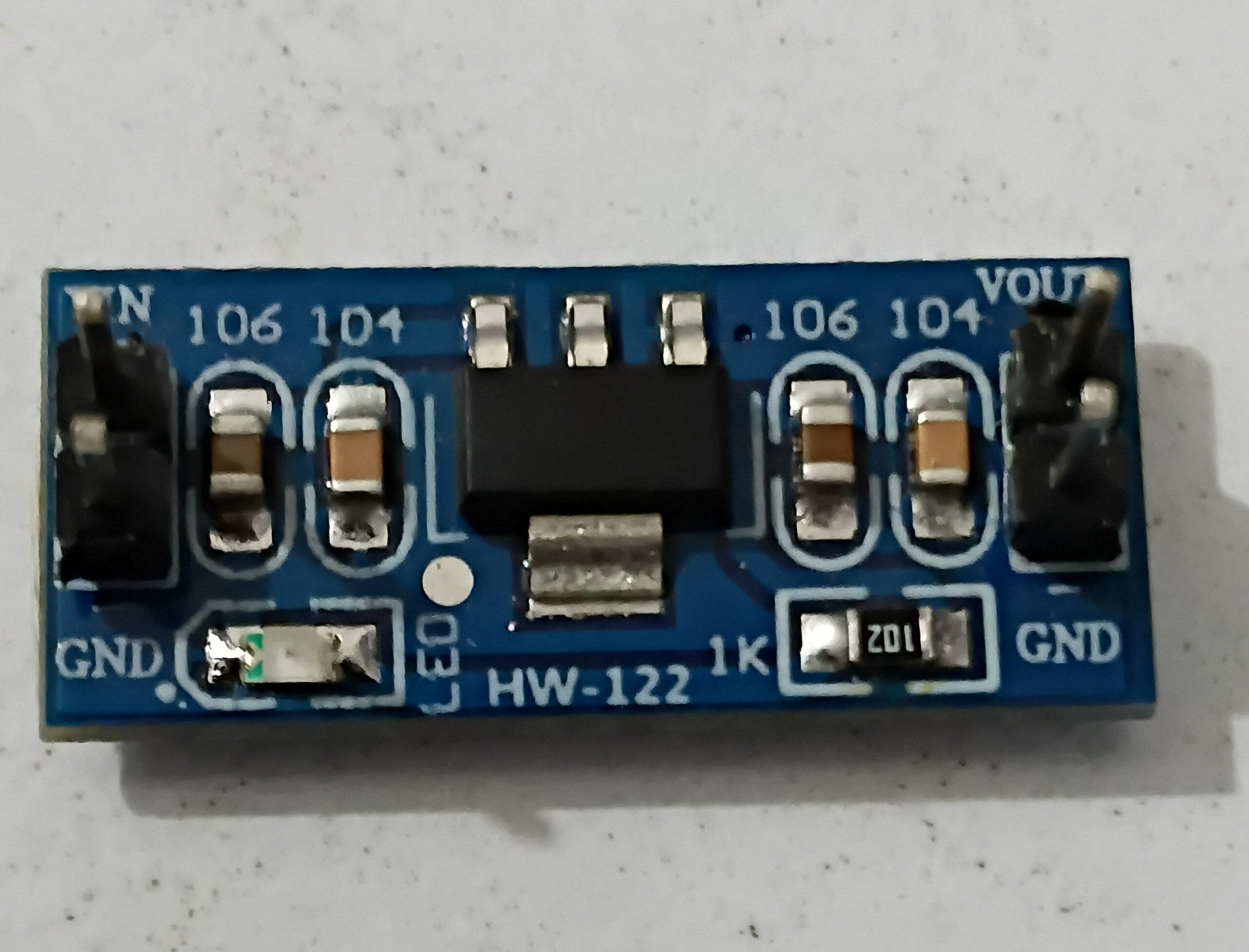
The AMS1117 is a 1990s bipolar LDO regulator still sold in cheap modules across India. The TLV740P is a 2020 CMOS regulator with 100× lower quiescent current, built-in protection, and genuine Texas Instruments silicon. This page breaks down exactly what that means for your circuit.
Key Takeaways — AMS1117 vs TLV740P
- Quiescent current: The TLV740P draws 50µA vs the AMS1117’s 5–10mA — 100× less power wasted at idle. In battery projects, this extends life from 25 days to over 2 years.
- Dropout voltage: The TLV740P needs only 460mV headroom vs 1.1–1.3V for the AMS1117. This eliminates MCU brownout resets during relay switching in 5V systems.
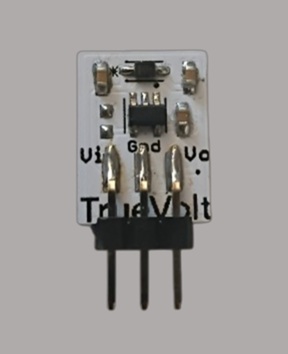
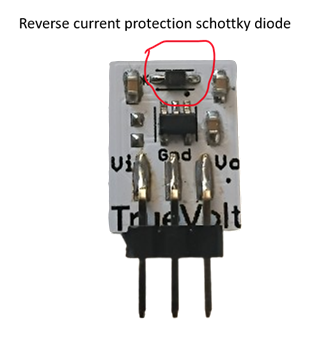
- Reverse protection: Cheap AMS1117 modules have no reverse current diode. The TrueVolt module includes a Diotec SD103AW Schottky diode for hot-plug safety.
- Clone risk: The AMS1117 is one of the most counterfeited ICs globally. The TrueVolt module uses genuine Texas Instruments TLV740P from authorized distribution.
- Thermal performance: Aluminum MCPCB runs 20–30°C cooler than FR4 boards used in generic modules.
- Best for: 5V USB-powered systems, battery IoT, ESP32/STM32/nRF52 power rails under 300mA.
- AMS1117 wins only on: Maximum current (1A vs 300mA) and input voltage range (15V vs 5.5V).
What You’re Actually Getting
Head-to-Head Specification Comparison
Every difference traces back to architecture: the AMS1117 uses a 1990s bipolar NPN/PNP pass transistor. The TLV740P uses a modern CMOS process with PMOS FET — fundamentally different silicon.
| Parameter | AMS1117-3.3 | TLV740P-3.3 (TrueVolt Module) | Winner |
|---|---|---|---|
| Design era | ~1997 (Bipolar) | 2020 (CMOS) | TLV740P |
| Dropout voltage | 1.1–1.3V | 460 mV | TLV740P |
| Quiescent current | 5–10 mA | 50 µA (100× lower) | TLV740P |
| Output accuracy | ±1.5% | ±1% | TLV740P |
| PSRR at high freq | Poor above 10 kHz | Good through 100 kHz+ | TLV740P |
| Output noise | 150 µVrms | Lower (modern CMOS) | TLV740P |
| Capacitor type | Tantalum (ESR-sensitive) | Ceramic MLCC (Samsung) | TLV740P |
| Reverse protection | None on most modules | SD103AW Schottky (Diotec) | TLV740P |
| Enable pin | Not available | Yes | TLV740P |
| Active discharge | Not available | Built-in | TLV740P |
| UVLO | Not available | Built-in | TLV740P |
| Inrush control | Not available | Built-in | TLV740P |
| Current limiting | Basic (5W in short circuit) | Foldback (self-protecting) | TLV740P |
| Thermal shutdown | Often missing in clones | Guaranteed — genuine TI | TLV740P |
| PCB material | FR4 | Aluminum MCPCB | TLV740P |
| Silicon authenticity | Clone risk — unverifiable | Genuine Texas Instruments | TLV740P |
| Pin compatibility | Module-specific | 7805 footprint (universal) | TLV740P |
| Max current | 1A (800mA practical) | 300 mA | AMS1117 |
| Input voltage | Up to 15V | Up to 5.5V | AMS1117 |
For loads under 300mA from a 5V source — which covers 90% of 3.3V MCU, sensor, and wireless module rails — the TLV740P module wins on 17 of 19 parameters.
Why These Specs Matter in Real Circuits
The Relay Reset Problem (Dropout Voltage)
In a 5V system, the AMS1117 has only 0.6V margin above dropout. When a 5V relay switches, the inrush spike sags the supply by 0.2–0.5V through USB cables and PCB traces. Two relays together push the AMS1117 into dropout — the 3.3V output dips, the ESP32’s brownout detector fires, and the MCU resets mid-operation.
The engineer then spends two days debugging firmware that was never broken.
The TLV740P at 460mV dropout keeps regulating down to 3.76V input. Even in worst-case relay scenarios, the output holds at 3.3V. The real cost of high dropout isn’t millivolts — it’s the engineering hours lost chasing phantom bugs.
Your Battery’s Worst Enemy (Quiescent Current)
An ESP32 in deep sleep draws 10 µA. The AMS1117 draws 5,000 µA — five hundred times more than the MCU it powers. Over 91% of your battery energy heats the regulator while your microcontroller sleeps.
With AMS1117: battery lasts 25 days.
With TLV740P: battery lasts ~2 years.
(3000mAh 18650, ESP32 deep sleep, 30-minute wake cycle)
This is architectural, not fixable. The AMS1117’s bipolar NPN pass transistor needs continuous base current to stay on. The TLV740P’s CMOS PMOS gate draws zero DC current. It’s baked into the silicon.
One Hot-Plug Away from Failure (Reverse Protection)
When you connect a powered board to an unpowered peripheral, current flows backwards through the LDO. The AMS1117 datasheet recommends a protection diode — but no cheap module includes one. We’ve inspected dozens from Indian suppliers. None had it.
A single hot-plug event can silently degrade the AMS1117. Output drifts from 3.30V to 3.18V, noise increases, regulation weakens. The engineer blames the sensor, the firmware, the MCU — never the LDO that was damaged weeks ago.
Our module has an authentic Diotec SD103AW Schottky diode — 0.3V forward drop, 1A surge rated — clamping reverse voltage before the TLV740P ever sees it.
Clone Roulette (Silicon Authenticity)
The AMS1117 is one of the most counterfeited ICs in the world. Independent testing shows parts from Chinese suppliers regularly fail basic specs: dropout 30–50% higher, thermal shutdown non-functional, failure by shorting output to input. These aren’t counterfeits — they’re production-line rejects from unknown fabs, remarked and sold as genuine. There’s no practical way to verify authenticity in the Indian supply chain.
Our module uses genuine Texas Instruments TLV740P from authorized distribution. Full lot traceability. Every spec is real. Every protection feature works.
Features the AMS1117 Simply Doesn’t Have
Enable Pin
Turn the 3.3V rail on/off from your MCU. Essential for power sequencing, sleep optimization, and fault recovery.
Active Discharge
Output pulls to ground when disabled. No ghost voltages, no incomplete resets, no power sequencing violations.
UVLO
Won’t attempt to regulate until input is sufficient. No partial-voltage startup, no corrupted MCU initialization.
Foldback Current Limit
In a short circuit, current reduces as voltage drops — keeping dissipation under 1W. The AMS1117 dumps 5W into a tiny SOT-223.
Aluminum MCPCB
Runs 20–30°C cooler than FR4 equivalents. Every 10°C reduction roughly doubles component lifetime.
7805 Pin Compatible
Drop-in for any TO-220 footprint. No PCB redesign. Works on breadboards and existing designs.
Who Should Use Which?
Use the TLV740P module when:
Load is under 300mA (ESP32, STM32, nRF52, sensors, displays, RF modules) · Battery life matters · Powering from 5V USB or 3.7V Li-ion · Reliability is non-negotiable · You’ve been burned by cheap modules before
AMS1117 might work if:
You need over 300mA at 3.3V (but ask: should this be a buck converter instead?) · Input exceeds 5.5V with no pre-regulation · Building a throwaway prototype where only cost matters
TrueVolt TLV740P Module — Full Specifications
| Output voltage | 3.3V (fixed) |
| Output accuracy | ±1% |
| Maximum output current | 300 mA |
| Input voltage range | 1.4V to 5.5V |
| Recommended input | 5V (USB, regulated supply) |
| Dropout voltage | 460 mV @ 300mA |
| Quiescent current | 50 µA |
| PSRR | 65 dB @ 1 kHz |
| Reverse protection | SD103AW Schottky (Diotec, authentic) |
| Input capacitor | 4.7 µF Samsung MLCC |
| Output capacitor | 4.7 µF Samsung MLCC |
| PCB material | Aluminum MCPCB |
| Pin compatibility | 7805 / TO-220 footprint |
| LDO IC | TLV740P (genuine Texas Instruments) |
| Protection features | Enable, active discharge, UVLO, foldback, thermal shutdown |
| Operating temperature | -40°C to 125°C |
| Manufacturer | Ramanu Systems, Pune, India |
| Best suited for | 5V input systems, battery IoT, MCU/sensor rails under 300mA |
Frequently Asked Questions
Upgrade Your 3.3V Rail
Drop-in 7805-compatible module. Genuine TI silicon. Aluminum PCB. Built for Indian conditions.