Buying guide · LCSC · Genuine parts · Passives · Evidence
Is LCSC Genuine? The Data, the Myths, and How to Buy Parts That Won’t Fail
Is LCSC genuine? Every electronics forum asks it, and the usual answer is “my parts worked”. Ours worked too. That is exactly the problem.
Same marking. Same 3.3 V output. Ten times the noise, and no meter on your bench will tell you.
Ramanu Systems engineering team · Pune, India · Data captured October 2026 · Updated 22 October 2026
We are not saying LCSC sells fake parts. We have no proof of that, and LCSC labels alternative brands with their real maker. The problem is subtler. Some alternatives carry the same part number stem and the exact same top marking as a famous original from TI, ADI or another big brand, but have a weaker spec. Once a part is off the reel, you can’t tell them apart by looking. LCSC is also not on the authorized-distributor lists published by TI or ADI, and TI gives no warranty for its parts bought outside its network.
Decide what you are paying for. Want the lowest price? Buy an Asian brand under its own part number and design to its own datasheet. Want the guaranteed spec? Buy from the maker (TI, ADI or any other brand) or its authorized distributor. And never save money on passives: capacitors, resistors and inductors carry no marking, and a cheap one fails silently, months later.
Key facts (October 2026)
- LCSC lists alternative brands under their real maker names. We found no evidence that LCSC itself sells counterfeit parts.
- LCSC is not listed as an authorized distributor on the TI or Analog Devices (ADI) distributor pages.
- TI states that it gives no warranty or support for TI parts bought outside its authorized network. ADI states that its authorized network is a way to make sure you get authentic ADI parts.
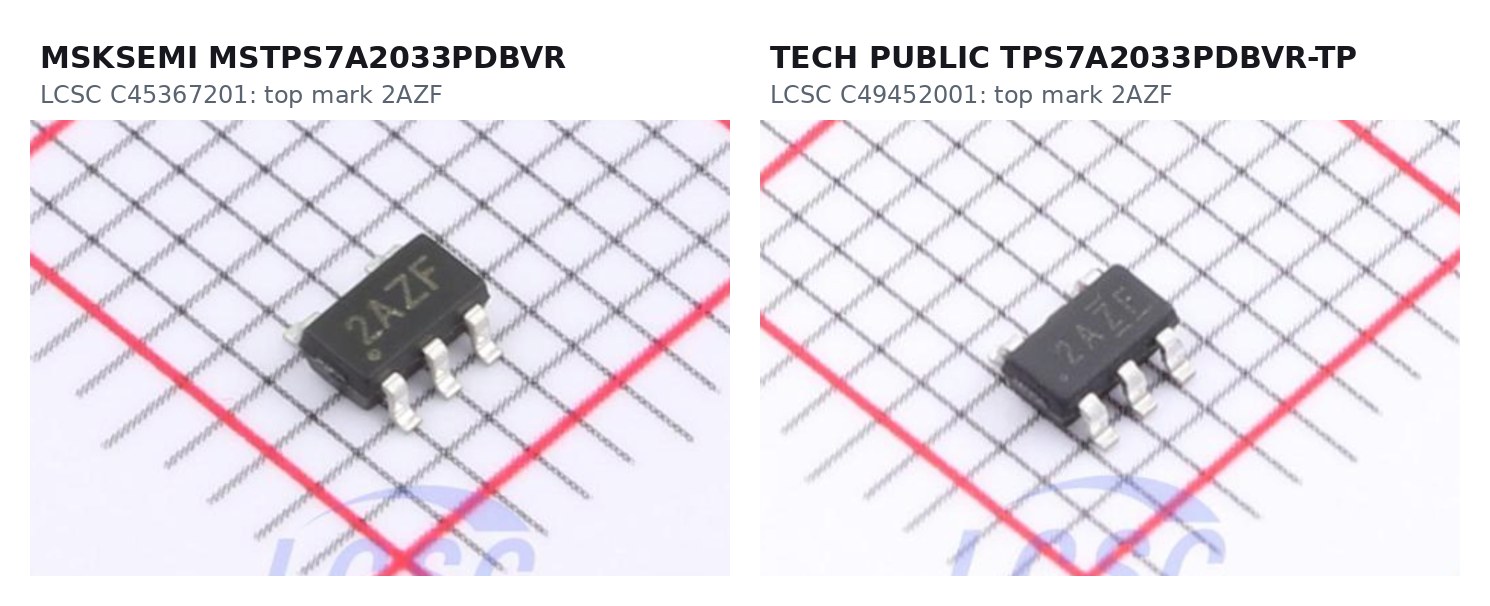
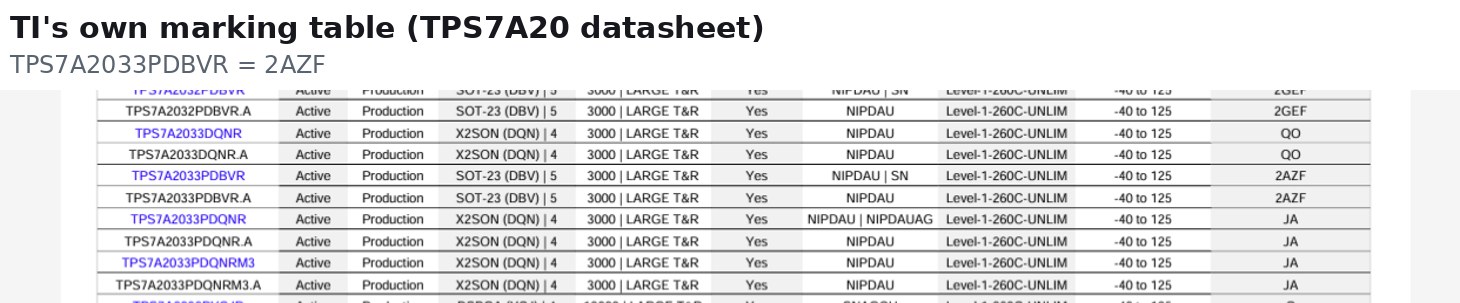
- At least two regulators listed on LCSC carry the same top marking,
2AZF, as TI’s TPS7A2033PDBVR. One of them specifies 70 µVrms output noise; TI specifies 7 µVrms. - A diode sold as TSD05DYFR-TP is rated for 18 A surge; TI’s TSD05 is rated for 60 A.
- For the lowest cost, buy other brands under their own part numbers and datasheets. For a guaranteed spec, buy from the maker or its authorized distributor.
- Capacitors, resistors and inductors carry little or no marking and can’t be verified once fitted. Buy branded passives from authorized distributors.
1. Why “it worked” proves nothing
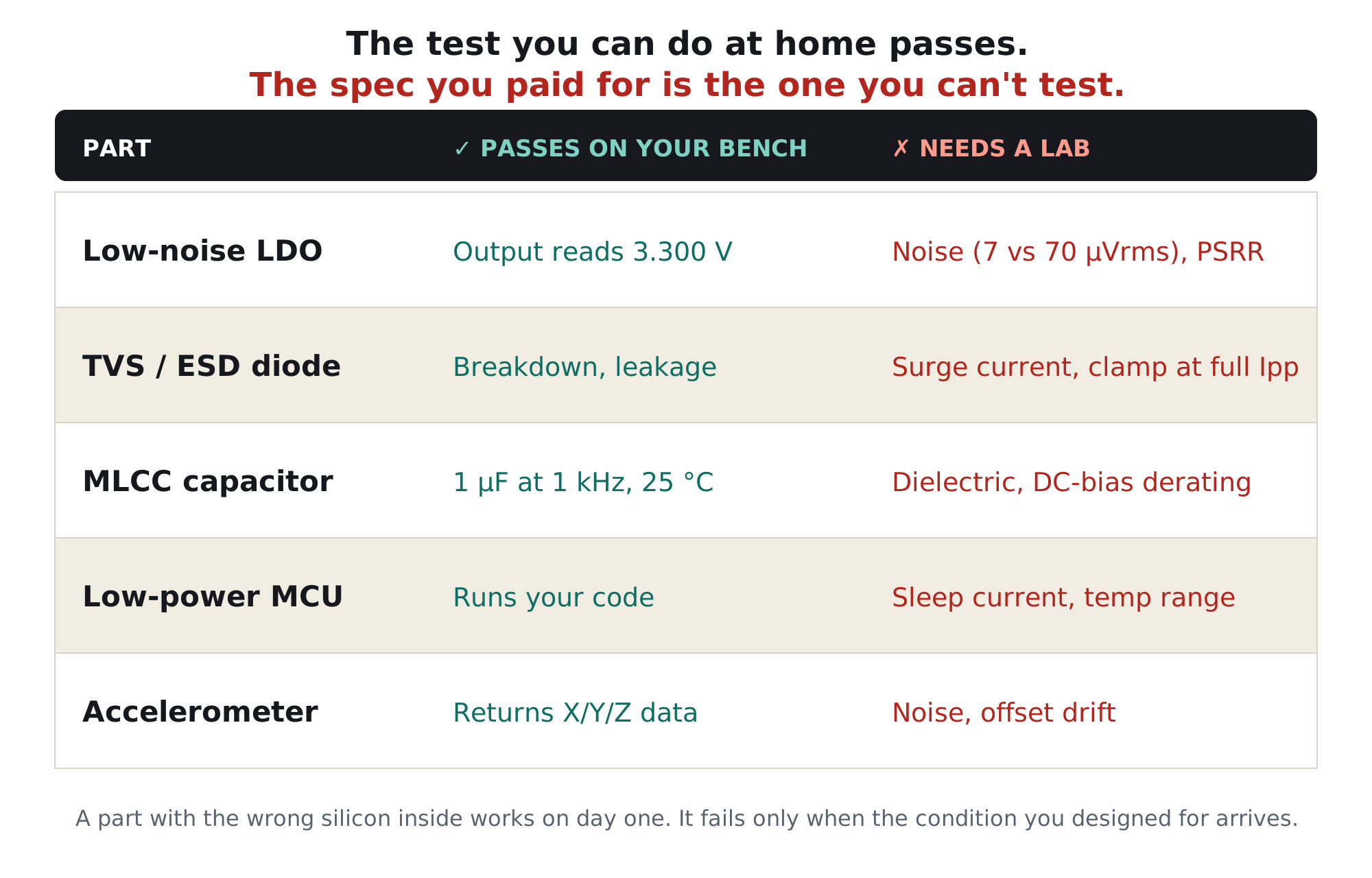
Every part on your board was chosen for a reason, and usually that reason is one number you paid extra for. A low-noise LDO is chosen for its noise. A TVS diode is chosen for the surge it can survive. A low-power MCU is chosen for its sleep current. An inductor is chosen for the current it can carry without saturating.
Those are exactly the numbers a normal bench can’t measure. A multimeter, a bench supply and “it runs my code” will pass almost any substitute. The part works on day one. It fails only when the condition you designed for finally arrives: a surge, a hot day inside an enclosure, the second year on a battery.
2. How a chip gets its price, and where the cheap ones come from
A chip’s price isn’t just silicon. The maker pays for the wafer, the package, and then a long final test that checks every part against every limit in the datasheet: noise, offset, quiescent current, leakage, the full temperature range. Not every part passes. The ones that do are sold through the maker’s own store and its authorized distributors, with the datasheet guarantee and a warranty. The price of every good part also pays for the ones that failed.
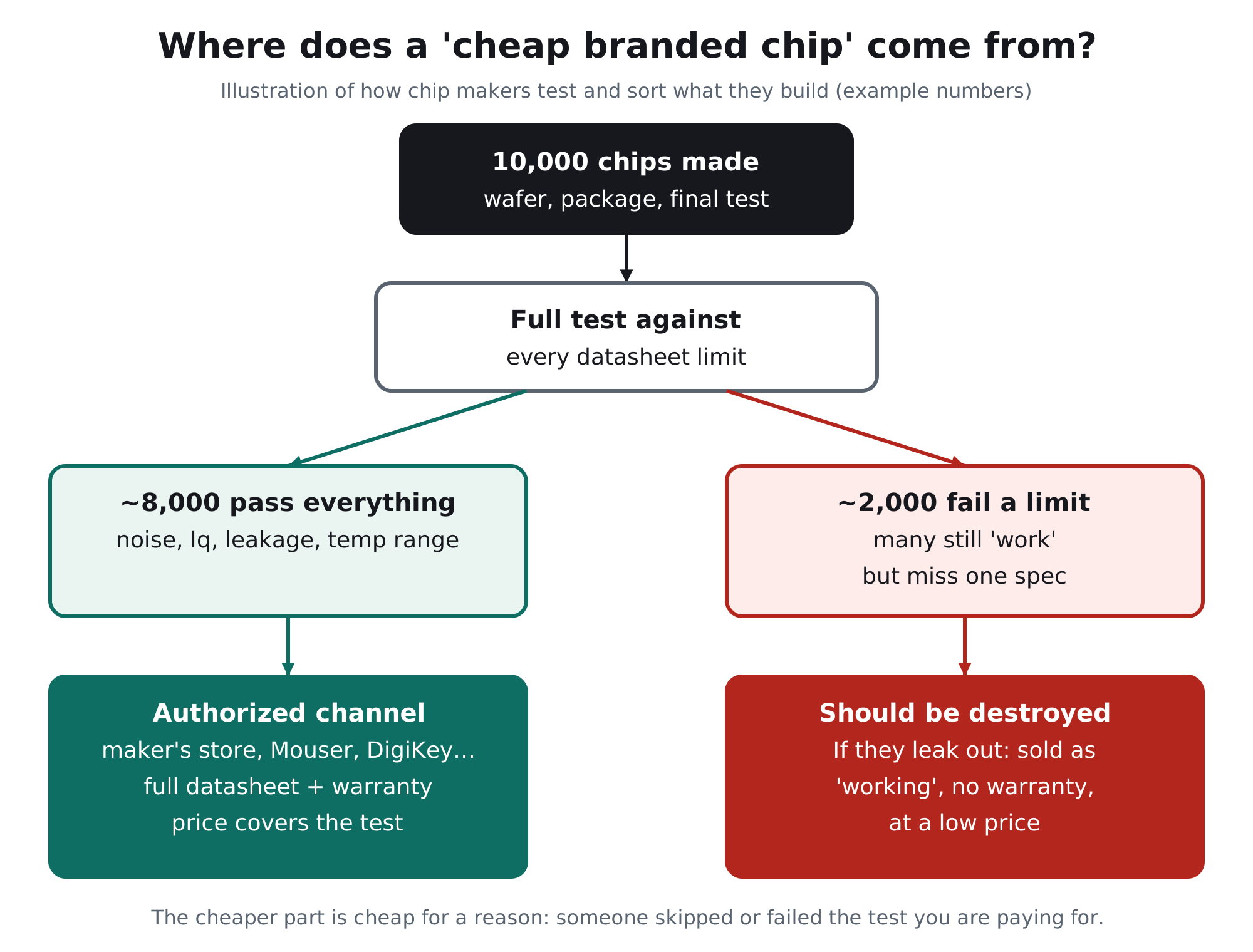
What happens to the parts that fail? Many of them still “work”. They power up, they regulate, they run code. They just miss one limit. They are supposed to be destroyed. A 2010 U.S. Department of Commerce study of counterfeit electronics counts “off-specification, defective, or used” parts sold as new or working as counterfeits, and recommends “physical destruction of all defective, damaged, and substandard parts”. Industry analyses list failed test lots, factory overruns and “seconds” that don’t meet the full datasheet as known ways parts leak into the market.
So when someone offers you a famous part number well below the maker’s own price, ask how. A chip that fails one limit can be sold cheaply as “working”, with no datasheet behind it and no warranty.
Why analog parts are the easiest to fake
A fake microcontroller that doesn’t run code gets caught on day one. An analog part is different: a weaker regulator still regulates, a weaker amplifier still amplifies, and a weaker TVS diode still clamps a small spike. What separates a premium analog part from a cheap one is noise, drift, PSRR, offset and surge rating, and measuring those needs lab equipment. That is why analog and protection parts are where substitution goes unnoticed the longest.
3. The evidence: chips with the same name, but not the same chip
Everything below comes from public sources you can check yourself: LCSC product pages, and each maker’s own datasheet, captured in October 2026. LCSC lists every one of these under its real maker, which is honest. The issue is that the part number and the marking don’t tell you which one you are holding. LCSC product photos may be representative images, so wherever we can, we also cite the maker’s own datasheet. Tap any image to see it full size.
Case 1 · Low-noise LDOTPS7A2033PDBVR: three chips, one marking
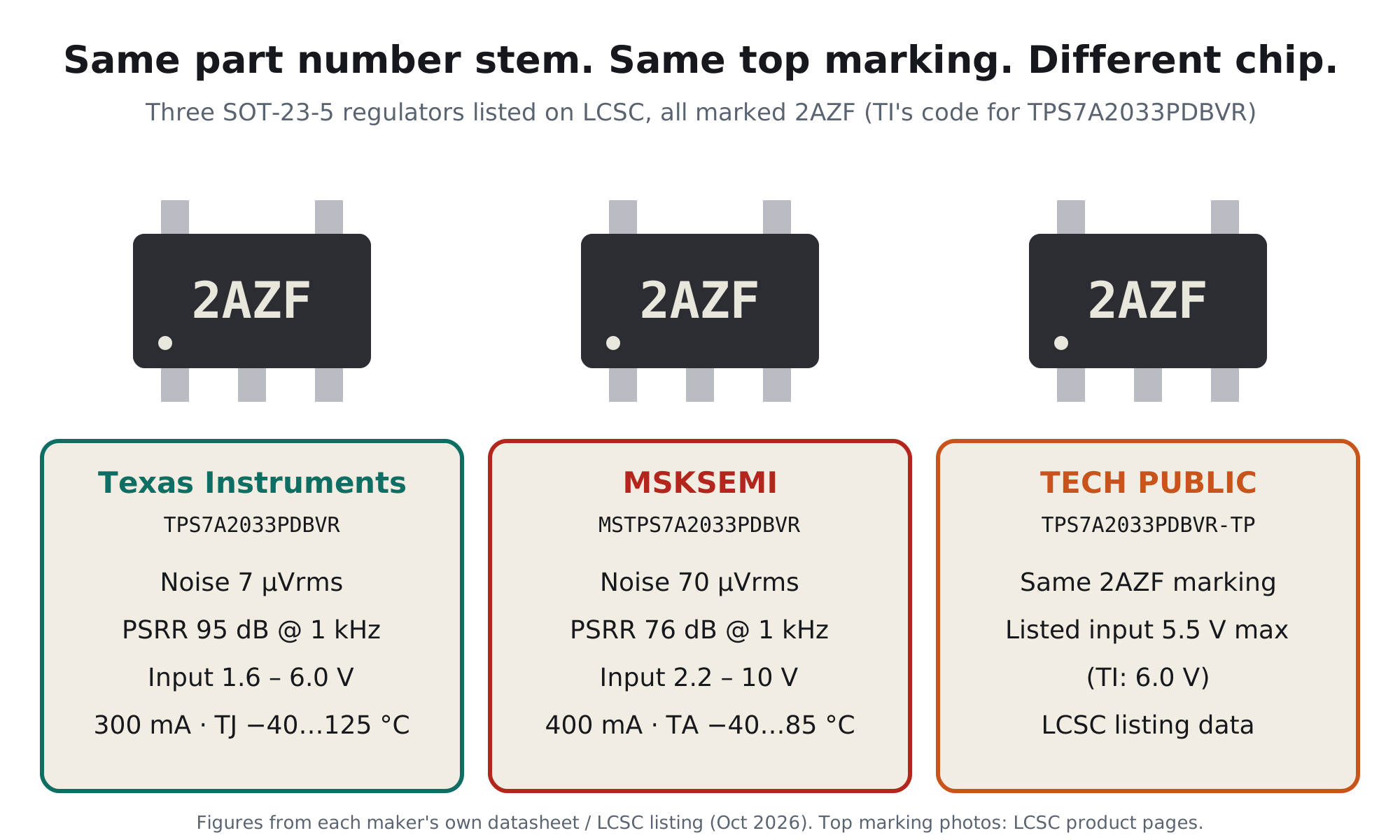
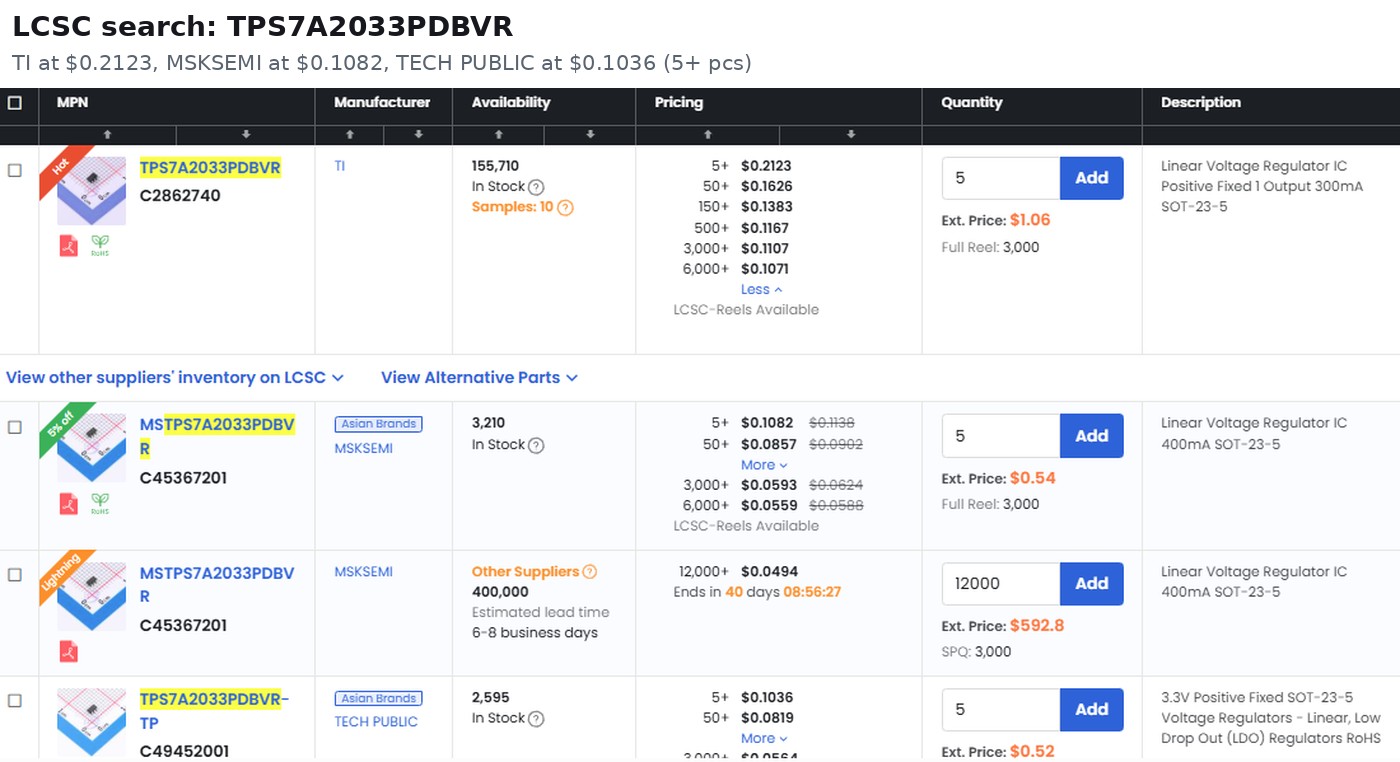
We use the TI TPS7A2033 for two numbers: 7 µVrms noise and 95 dB PSRR at 1 kHz. Search LCSC for it and you get the TI part plus two alternatives. Both have “TPS7A2033PDBVR” in their part numbers, and both show TI’s top mark, 2AZF, in their LCSC photos. MSKSEMI’s own datasheet lists 2AZF as its marking too.
| Parameter | TI TPS7A2033PDBVR | MSKSEMI MSTPS7A2033PDBVR |
|---|---|---|
| Output noise (10 Hz–100 kHz) | 7 µVrms | 70 µVrms (10×) |
| PSRR at 1 kHz | 95 dB (20 mA) | 76 dB (50 mA) |
| Input voltage | 1.6–6.0 V (abs. max 6.5 V) | 2.2–10 V (abs. max 12 V) |
| Output current | 300 mA | 400 mA |
| Accuracy | ±1.5% over line, load and temperature | ±2% at 25 °C, 1 mA |
| Dropout | 145 mV max at 300 mA | 75 mV typ at 50 mA only |
| Current limit | 360–730 mA, guaranteed | Not specified |
| Temperature | TJ −40 to 125 °C | TA −40 to 85 °C |
Don’t take our word for it. Here are the two datasheets, with the rows that matter highlighted:
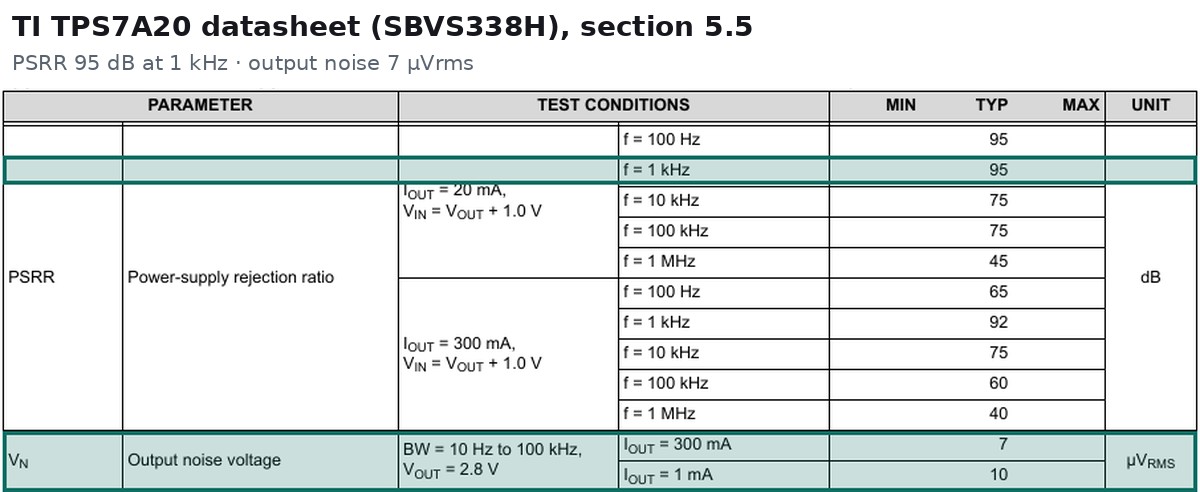
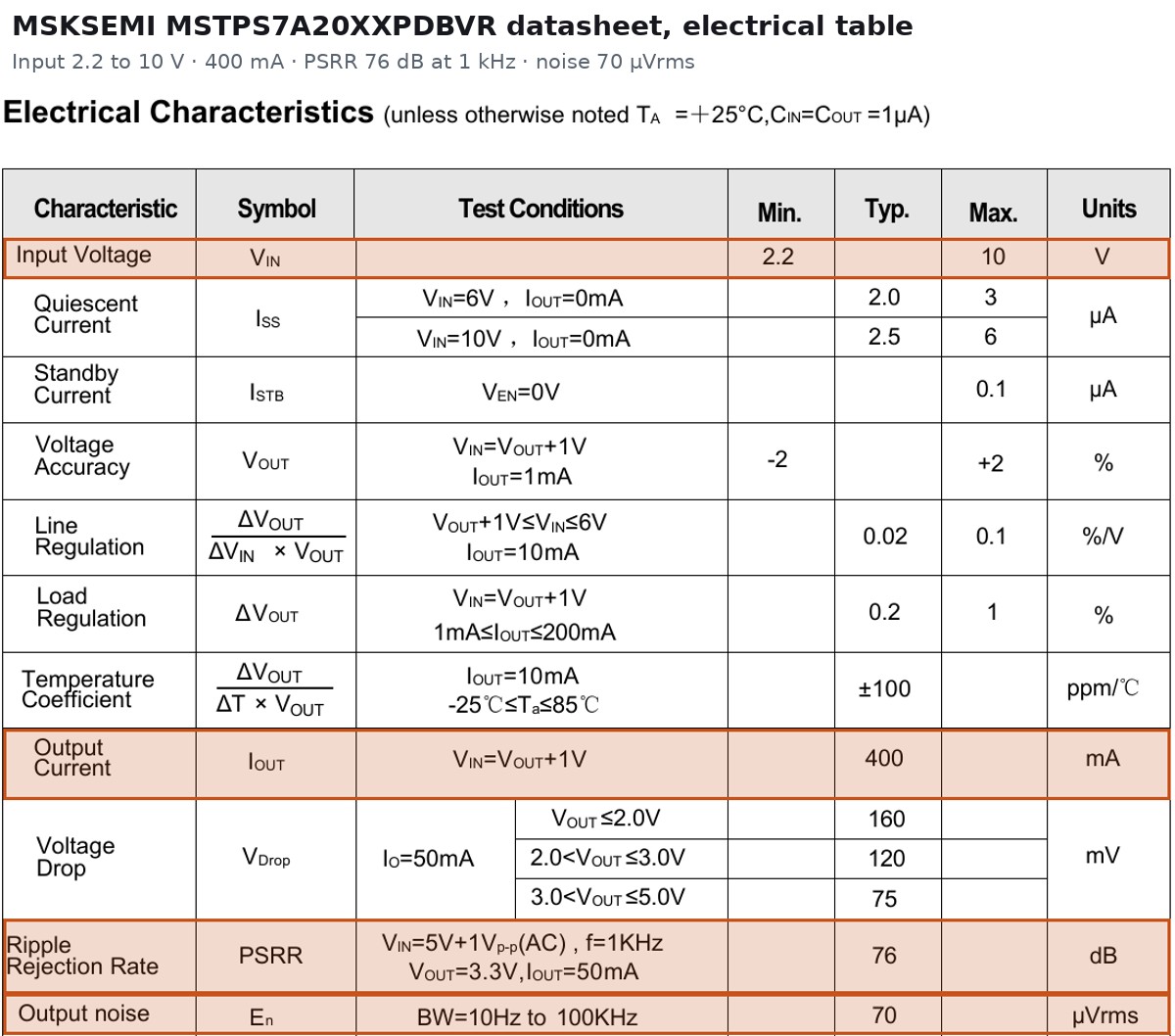
This is a different circuit design that shares TI’s pinout and marking. Its output voltage is right, so it passes every quick test. But the two numbers you bought a TPS7A20 for are 10 times and about 19 dB worse. (TECH PUBLIC’s listing gives a 5.5 V maximum input against TI’s 6.0 V. We haven’t reviewed its full datasheet here.)
| Price per piece (Oct 2026) | Small qty | Reel qty |
|---|---|---|
| TI on TI.com | ₹26.96 (1–99) | ₹9.40 (1,000+) |
| TI on LCSC | $0.2123 (5+) | $0.1071 (6,000+) |
| MSKSEMI on LCSC | $0.1082 (5+) | $0.0559 (6,000+) |
| TECH PUBLIC on LCSC | $0.1036 (5+) | $0.0532 (6,000+) |
How easy is it to sell a different chip under a famous name?
Unfortunately, easy. Anyone further down the chain can do it, without LCSC or the alternative’s maker being involved:
- Buy the alternativeA part with TI’s pinout and TI’s top marking, at half TI’s price or less, sold openly under its own brand.
- Change the label, not the chipCut it off the reel and put it in a bag or a new reel labelled “TI TPS7A2033PDBVR”. Or fit it to a module and list the module as “TI TPS7A2033 based”.
- Sell it as TIThe buyer checks the marking (2AZF, correct), the pinout (correct) and the output (3.300 V, correct). Every check passes. The one test that would fail, a noise measurement at the 7 µVrms level, is one almost nobody can do. The seller keeps the price difference. You paid more than the honest alternative costs, and you didn’t get the spec you paid for.
Nothing on the chip tells you which maker built it. That is why the seller matters more than the marking.
Case 2 · Protection diodeTSD05DYFR: same name, a different kind of diode
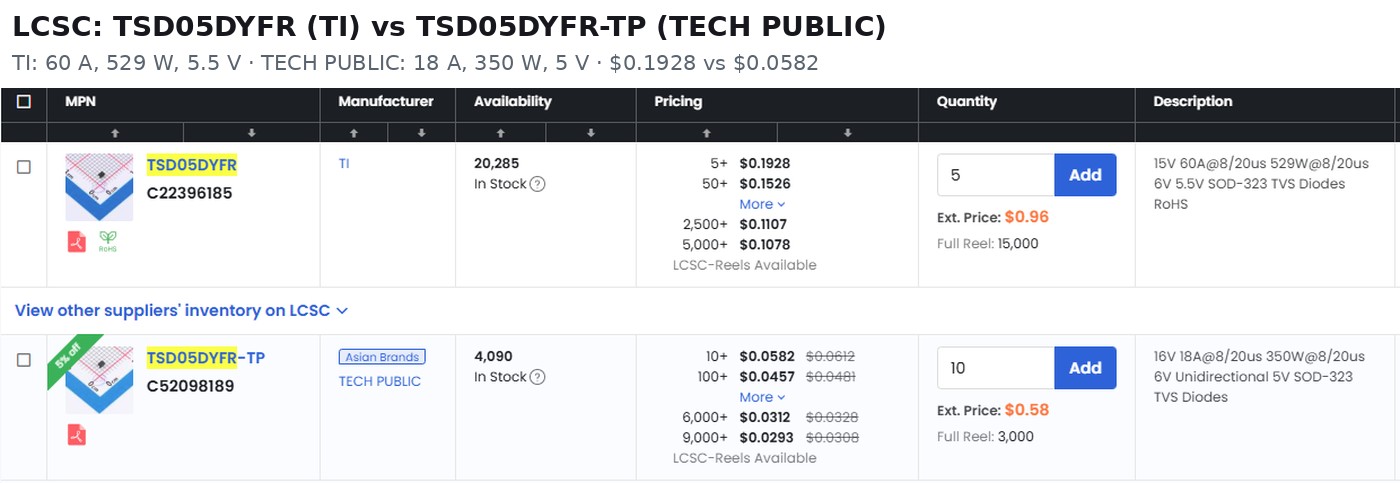
TI’s TSD05 is a surge TVS diode for a 5 V line. TECH PUBLIC’s “TSD05DYFR-TP” comes in the same SOD-323 package, but it is a low-capacitance ESD steering diode with less than a third of the surge rating.
| Parameter | TI TSD05 | TECH PUBLIC TSD05DYFR-TP |
|---|---|---|
| Peak pulse current (8/20 µs) | 60 A | 18 A |
| Peak pulse power | 529 W | 350 W |
| Working voltage (VRWM) | 5.5 V | 5.0 V |
| Clamping voltage | 11.5 V max at 24 A; 15 V max at 60 A | 9 V max at 1 A; 16 V typ at 18 A |
| Leakage | 50 nA max at 5.5 V | 200 nA max at 5 V |
| Capacitance | 19 pF | 1 pF |
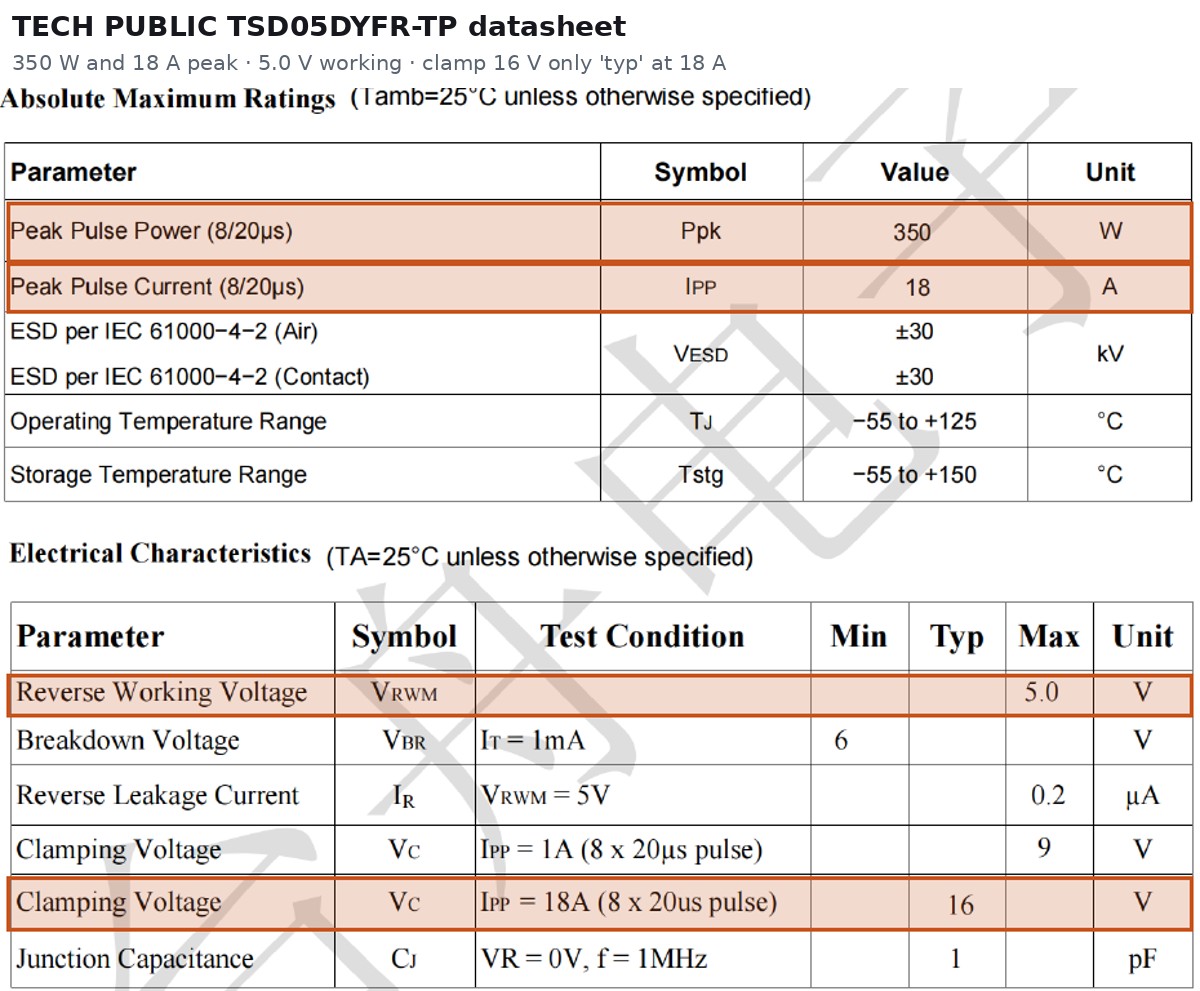
On a 5 V power input, you designed for 60 A of surge and got 18 A. Save a few rupees on the diode, lose the ₹1000 controller behind it. How many people can test a surge rating at home? Almost nobody: it needs a surge generator, and the test destroys the part. Its datasheet doesn’t add up either: 18 A × 16 V is 288 W, not the 350 W it lists.
Case 3 · 7805 regulatorL7805: a photo that doesn’t match the datasheet
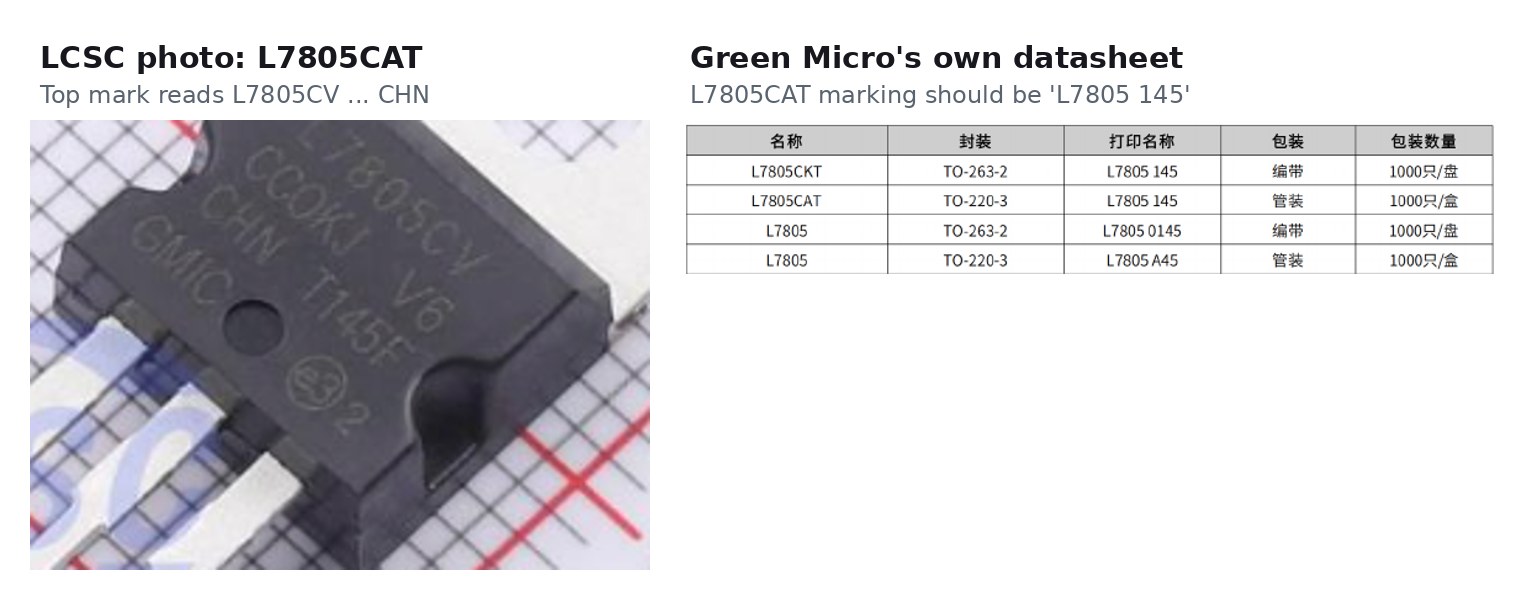
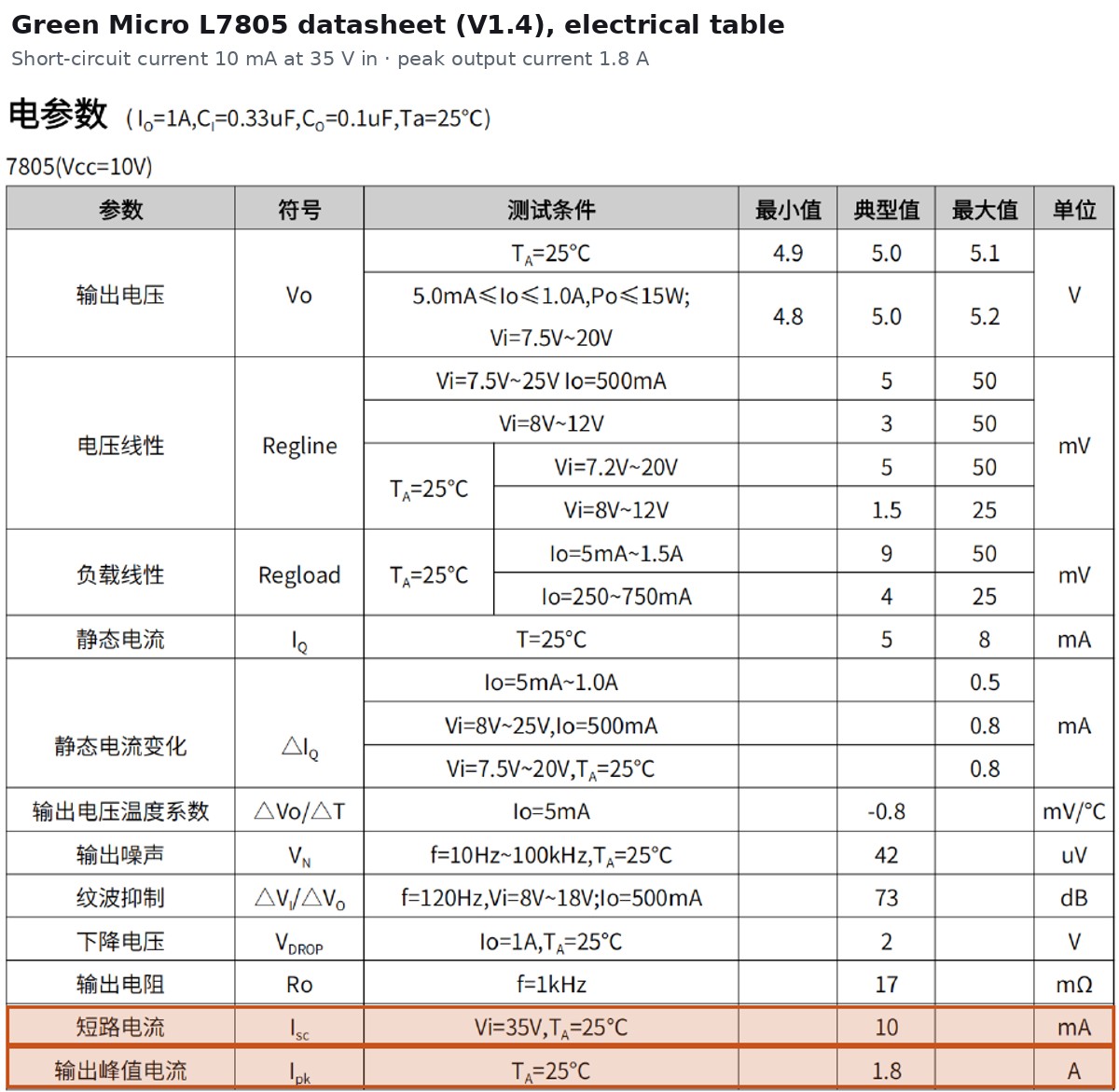
Green Micro’s own datasheet says its L7805CAT is marked L7805 145. The LCSC product photo for that part shows L7805CV … CHN … e3, which is the part number STMicroelectronics uses for its own 7805. The photo may simply be a representative image, but it shows the problem: anyone looking at that chip would read it as an ST part. The datasheet has its own surprise. It lists a short-circuit current of only 10 mA at 35 V input, which is either a very weak limit or an error in the datasheet. (TI specifies 2.1 A for its LM7805, under different test conditions.) A second 7805 on LCSC, from TDSEMIC, shows another warning sign: its application drawing carries another maker’s name (UTC), and its quiescent-current table and graph disagree.
ADXL345 and DRV8825: when the module costs less than the chip
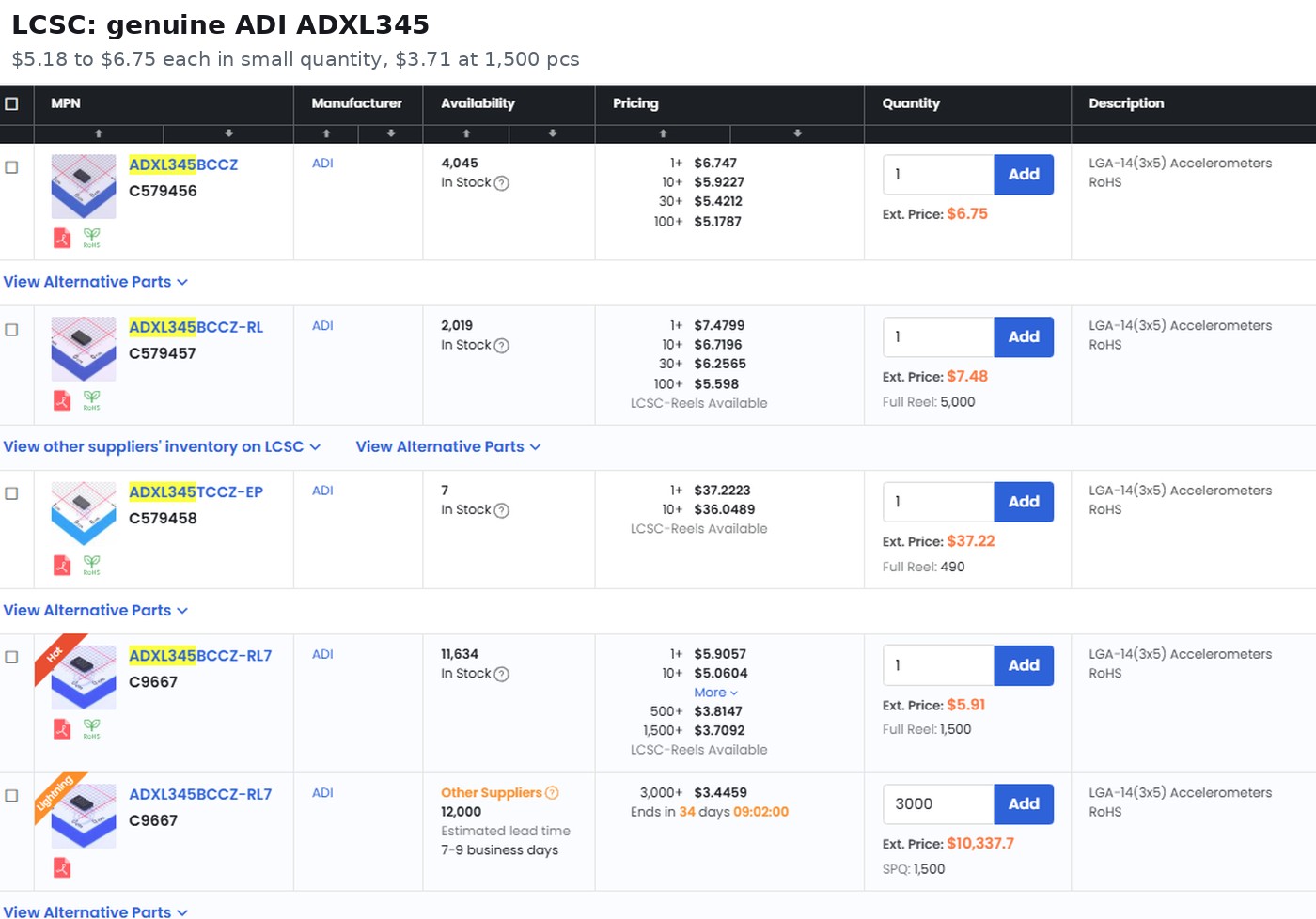
Sometimes arithmetic is enough. LCSC sells the genuine Analog Devices ADXL345 at $5.18 to $6.75 each in small quantities, and $3.71 even at 1,500 pieces. That’s roughly ₹300 for the chip alone. ADXL345 modules sell in India for around ₹250, including the PCB, a regulator, assembly, shipping and the seller’s profit. The TI DRV8825 stepper driver costs $1.57 to $2.41 per chip. If a finished module costs about the same as the genuine chip, or less, it is very unlikely that the chip on it came through the maker’s normal channel.
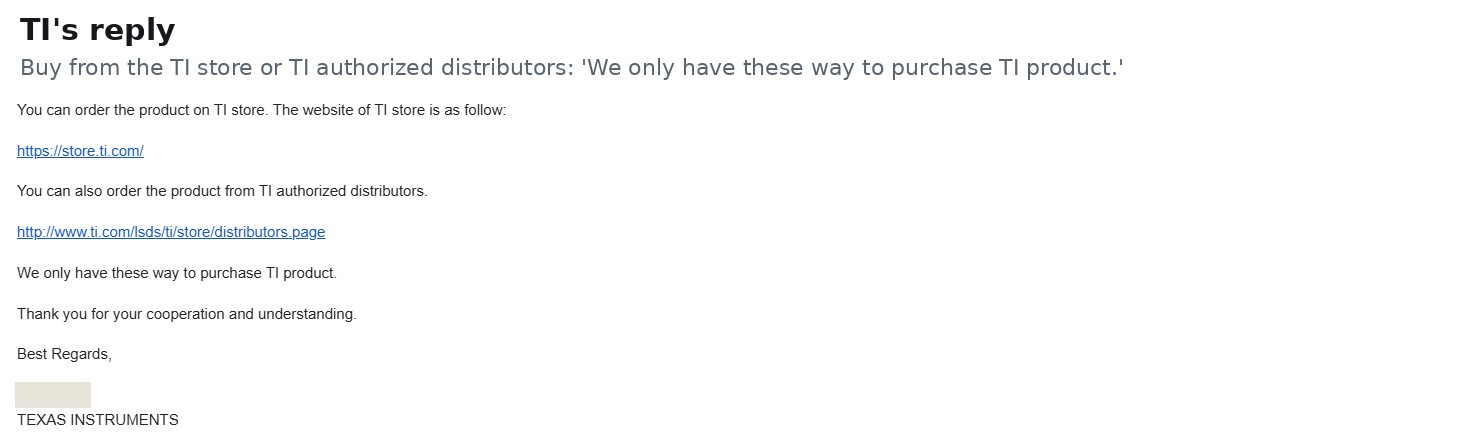
We asked TI this exact question years ago. DRV8825 breakout boards were selling in India for about ₹200 with a heatsink, while the bare TI chip cost about ₹290 at element14. Were the boards using copies? Lower-grade TI parts? TI’s answer was short: buy from the TI store or TI’s authorized distributors. “We only have these way to purchase TI product.” TI’s distributor page says the same in writing: TI gives no warranty or support for TI parts bought from brokers, independent distributors or online marketplaces. Analog Devices puts it more gently: its authorized network is “one way you can ensure you are purchasing authentic ADI products”.

4. The honest way to save: cheap parts under their own name
The price tests above have a positive side. Other makers sell similar functions for a fraction of the price, openly, under their own part numbers and datasheets. When cost matters most, that is a perfectly good choice. The only thing to watch for is the opposite: a cheap part wearing a famous name.
Can a cheap accelerometer be sold as an “ADXL345”?
Look at what other makers charge for accelerometers under their own part numbers: about $0.15 to $0.39 each, against $5 or more for the genuine ADXL345.
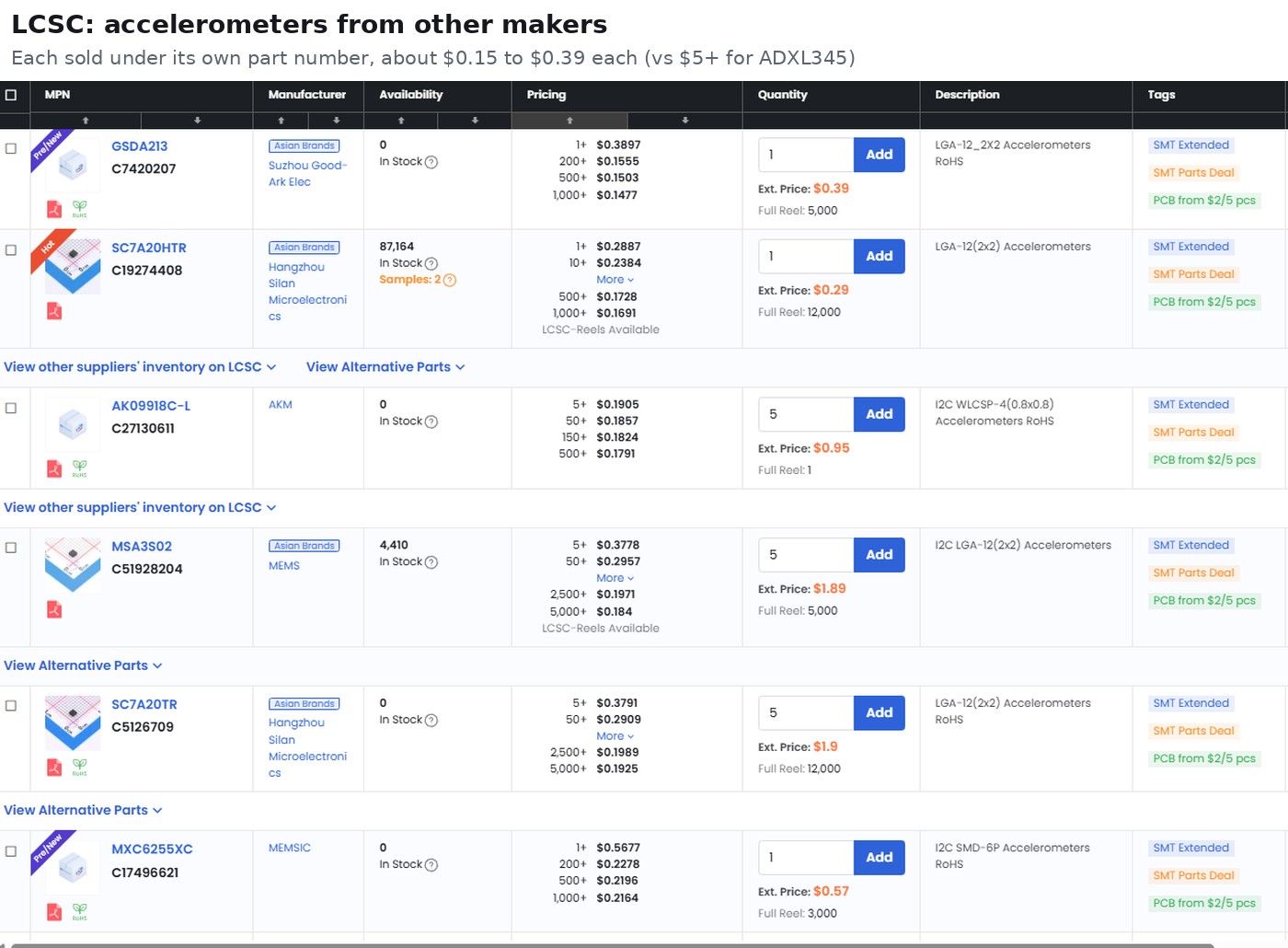
This picture carries two messages.
The good one: you don’t have to pay ADXL345 prices. If your project just needs to sense tilt, motion or a tap, a 3-axis accelerometer such as the Silan SC7A20 or the MSA3S02 costs roughly ₹15 to ₹35 and comes with its own datasheet. It is a different chip, so plan for a different footprint (a smaller LGA-12, 2×2 mm package), a different driver library, and its own limits for range, noise and current. Read its datasheet, design to it, and you have an honest low-cost part.
The caution: the price gap also tempts the wrong kind of seller. These particular parts can’t pass as an ADXL345: the package, pins and registers are all different, and an ADXL345 library would not find them. A part built to the ADXL345’s package and register map, though, could carry the ADXL345 marking. It could pass every hobby test: it fits the footprint, the library finds it, it returns X, Y and Z. What you can’t check at home is its noise, its offset, or how it drifts with temperature. It is the same situation as the 2AZF regulators.
Can a cheap motor driver be sold as a “DRV8825”?
The genuine TI DRV8825 costs $1.57 to $2.41 per chip. Small motor-driver ICs from other makers cost about $0.025 to $0.05.
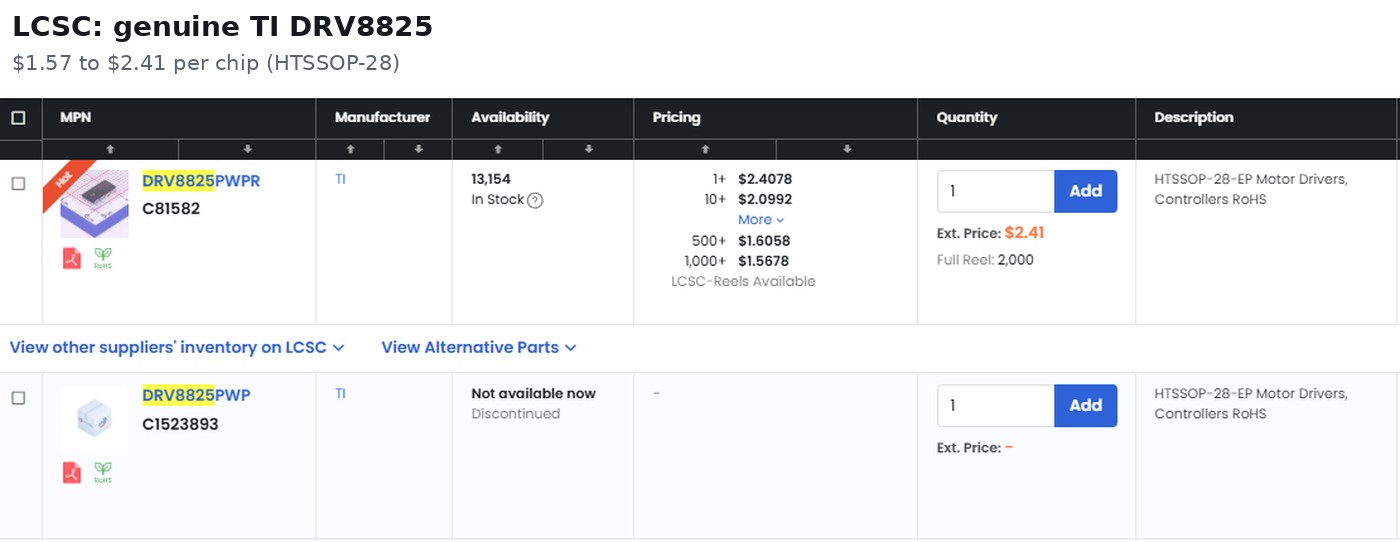
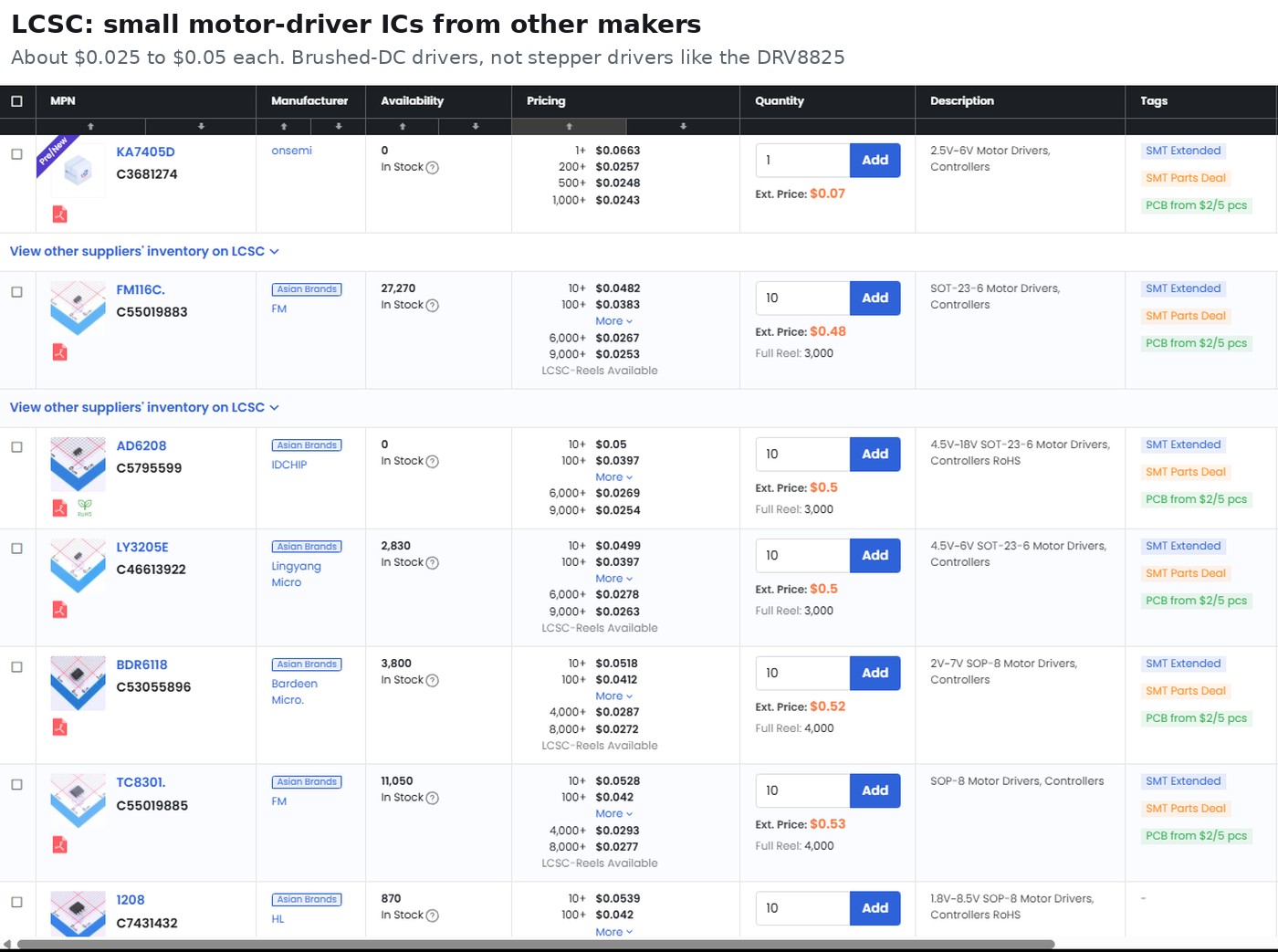
Again, two messages.
The good one: match the driver to the motor. The parts in this listing (for example FM116C, LY3205E, BDR6118 or TC8301) are small brushed-DC motor drivers in SOT-23-6 and SOP-8 packages, at under five US cents each. If you are driving a small DC motor in a toy, a lock, a pump or a fan, one of these with its own datasheet may be all you need. You don’t need a ₹150 stepper driver for that job. For a stepper motor, look for a stepper driver from another maker under its own part number, and check its current rating, microstepping and protection in its datasheet.
The caution: these small parts can’t replace a DRV8825. But a stepper driver built to the DRV8825’s 28-pin package and pinout could be marked “DRV8825” and sold as one, and it would turn your motor. Whether its current regulation, microstepping accuracy and thermal protection match TI’s datasheet would only show up later, as missed steps or an overheating driver.
To be fair: missed steps and overheating can also come from the module itself, through wrong sense resistors, a weak heatsink or a badly set current limit. A genuine chip on a poor board can fail the same way. And a module priced below the genuine chip may carry a recycled, rejected or remarked part rather than a purpose-built clone. The price test tells you the chip didn’t come from TI’s channel. It can’t tell you which of these you got, and that is exactly the problem.
5. The myth: “a capacitor is a capacitor”
This is where most makers save money, and it is the most dangerous place to do it. ICs at least carry a marking you can compare. Passives carry nothing. A 0805 capacitor is a plain brown rectangle, and a chip resistor often has no code at all. The only identity a passive has is the label on its reel, and after soldering, not even that.
The price gap can be large: depending on the value and where you buy it, an unbranded capacitor can cost a small fraction of a branded one from an authorized distributor. With no marking to check, a passive is also the easiest part of all to swap for something cheaper. You will never know when it fails, or why.
Capacitors: the value you see isn’t the value you get
A normal LCR meter measures at 1 kHz, with no DC bias, at room temperature. Every capacitor passes that test. What you actually chose the capacitor for is invisible:
- Dielectric. An X7R and a Y5V both read 1 µF at 25 °C. A Y5V part can lose up to around 80% of its capacitance across temperature.
- DC-bias derating. A ceramic capacitor loses capacitance as voltage is applied. We pick ours from the maker’s published DC-bias curve, using the value at our operating voltage. A different brand with the same “1 µF 10 V X7R” label can follow a very different curve. Our DC-bias article shows how much case size alone changes this, even within one brand.
- Voltage rating and reliability. A lower-rated part works until the first spike. Cracking, aging and moisture show up months later.
Here is how that hurts. A low-noise LDO needs a minimum real output capacitance to stay stable. Fit a capacitor that has lost most of its value at your voltage, and the regulator can ring. A cheap unknown capacitor can ruin a genuine, more expensive regulator.
Resistors: tolerance is only the first line
A resistor’s datasheet covers much more than “10 kΩ ±1%”. Branded makers publish the temperature coefficient (how far the value drifts as the board heats up), a power derating curve (a 0805 rated for 1/8 W at 70 °C carries less when hotter), pulse and surge ratings for parts that see inrush or ESD, and sulfur resistance. Silver in ordinary thick-film resistors can corrode in sulfur-rich air and go open-circuit, so the big makers sell anti-sulfur series. An unbranded resistor gives you a value and a tolerance, and nothing about how it behaves hot, under a pulse, or after three years in a factory.
Inductors: the cheap core gives up first
An inductor’s value comes from its core, and the core’s quality is invisible. Every ferrite core saturates: above a certain current, the inductance collapses. It saturates sooner when it is hot. A good maker states the saturation current, the current for a safe temperature rise, and curves of inductance against current, so you can pick a part with margin. An unbranded “10 µH” may use a lower-grade ferrite and come with none of these numbers.
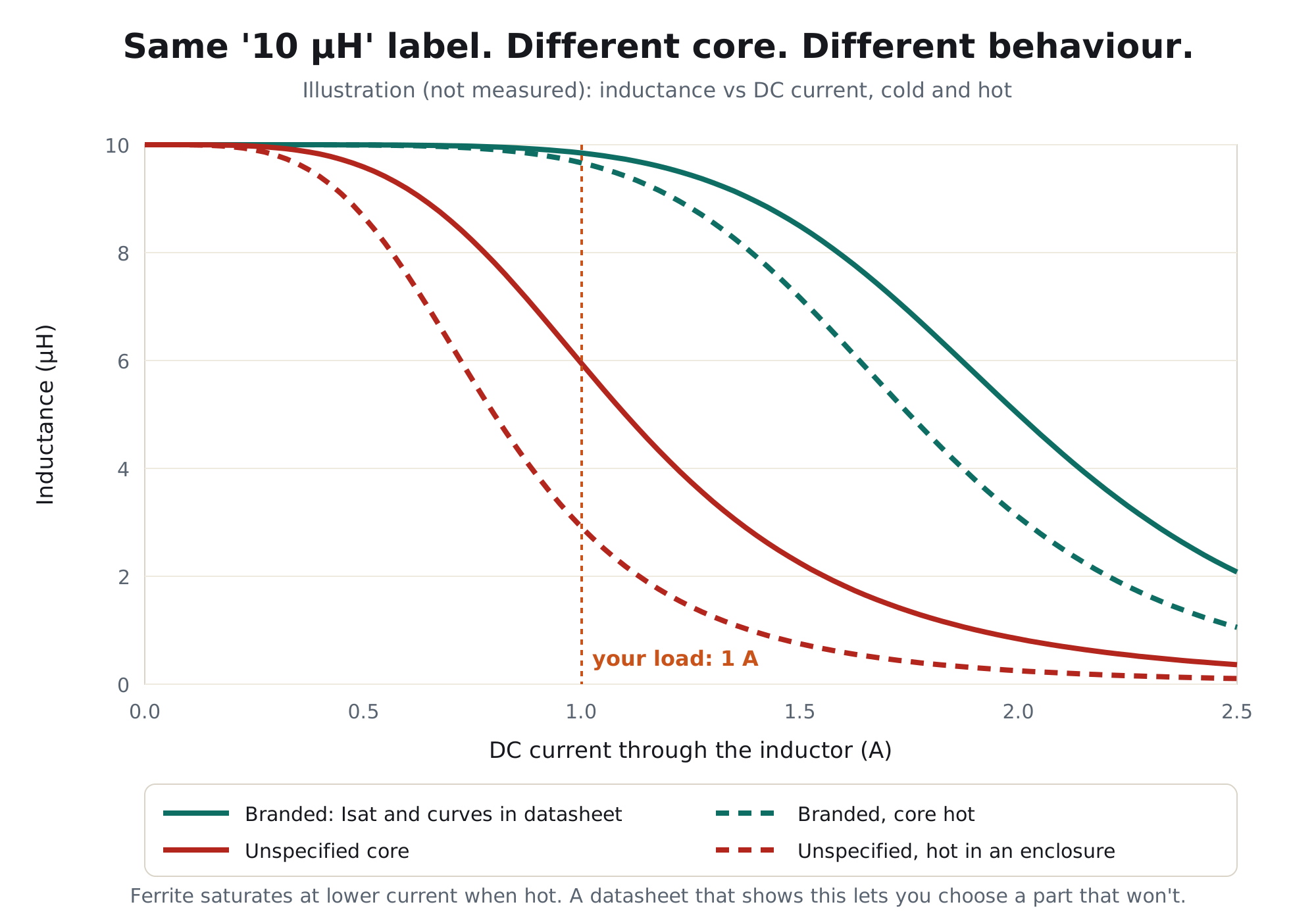
In a buck converter, a saturating inductor lets current spike on every cycle. The switch and the diode run hotter, the output gets noisy, and eventually something fails. It works on your open bench and fails in the customer’s sealed box in summer. A branded inductor’s datasheet lets you choose a part that won’t do that.
6. What cheap parts really cost
The saving from cheap parts is easy to see: it’s on the invoice today. The cost arrives later, from the field, and it is much bigger.
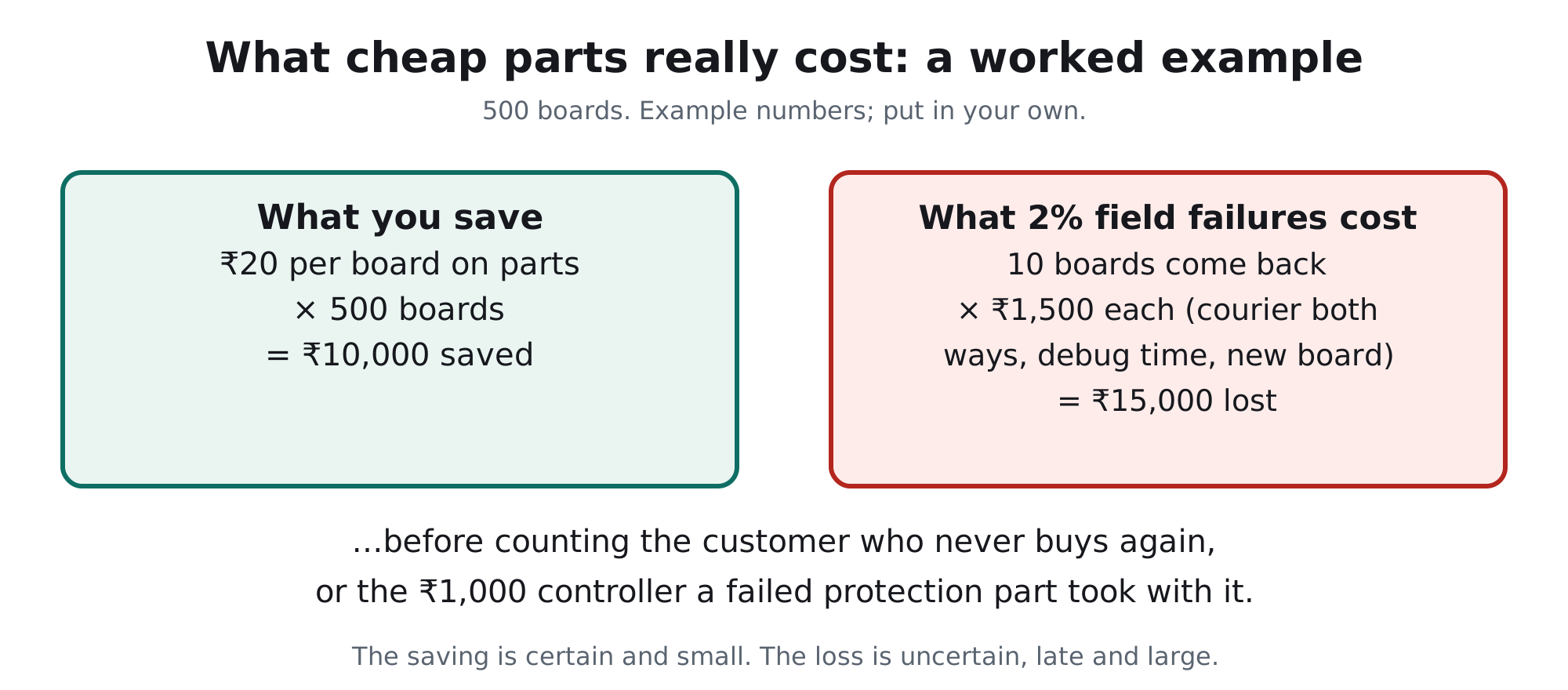
That is before you count debugging time. In our plant-watering project, a cheap display caused a hang that took about 10 hours to track down, and it only appeared after a few months in the field. The rest of the board used genuine parts, and the cheap part cost more than it saved.
7. Who pays the price of a fake part?
A fake or out-of-spec part hurts everyone who uses it, but in different ways:
| Who | What a fake part does to them | Why they need genuine parts |
|---|---|---|
| Students | The project fails at the demo or the viva. Weeks go into debugging a “bad design” that is really a bad part. Worse, they learn the wrong lesson: that their correct circuit is wrong, or that a bad circuit is fine. | Learning only works when the part behaves like its datasheet. Then the result, good or bad, teaches you something. |
| Hobbyists and makers | Burnt boards, a printer that misses steps, sensors that drift. Money and weekends lost, and no way to know whether the code or the part is to blame. | One less unknown. When the part is genuine, the problem is in your design, where you can fix it. |
| Design engineers | The prototype passes and production fails, or the opposite. Results can’t be repeated. Design decisions are based on wrong numbers. A weak protection part can fail EMC or safety testing, costing a full re-test. | Your design is only as good as the guaranteed limits you designed to. Without them, your margins are guesses. |
| Startups and small manufacturers | Field returns, warranty costs, angry customers, bad reviews. One bad batch can wipe out the profit of many good ones, and the brand may not recover. | Every return costs more than the saving. Traceable parts also let you find and contain a bad batch. |
| Manufacturing industry (industrial, automotive, medical) | Production-line downtime, product recalls, safety incidents, legal liability. Customers and regulators may demand to know where every part came from. | Reliability, safety and traceability. In these markets, using parts from unauthorized sources can itself be a contract or compliance breach. |
8. So what should you buy?
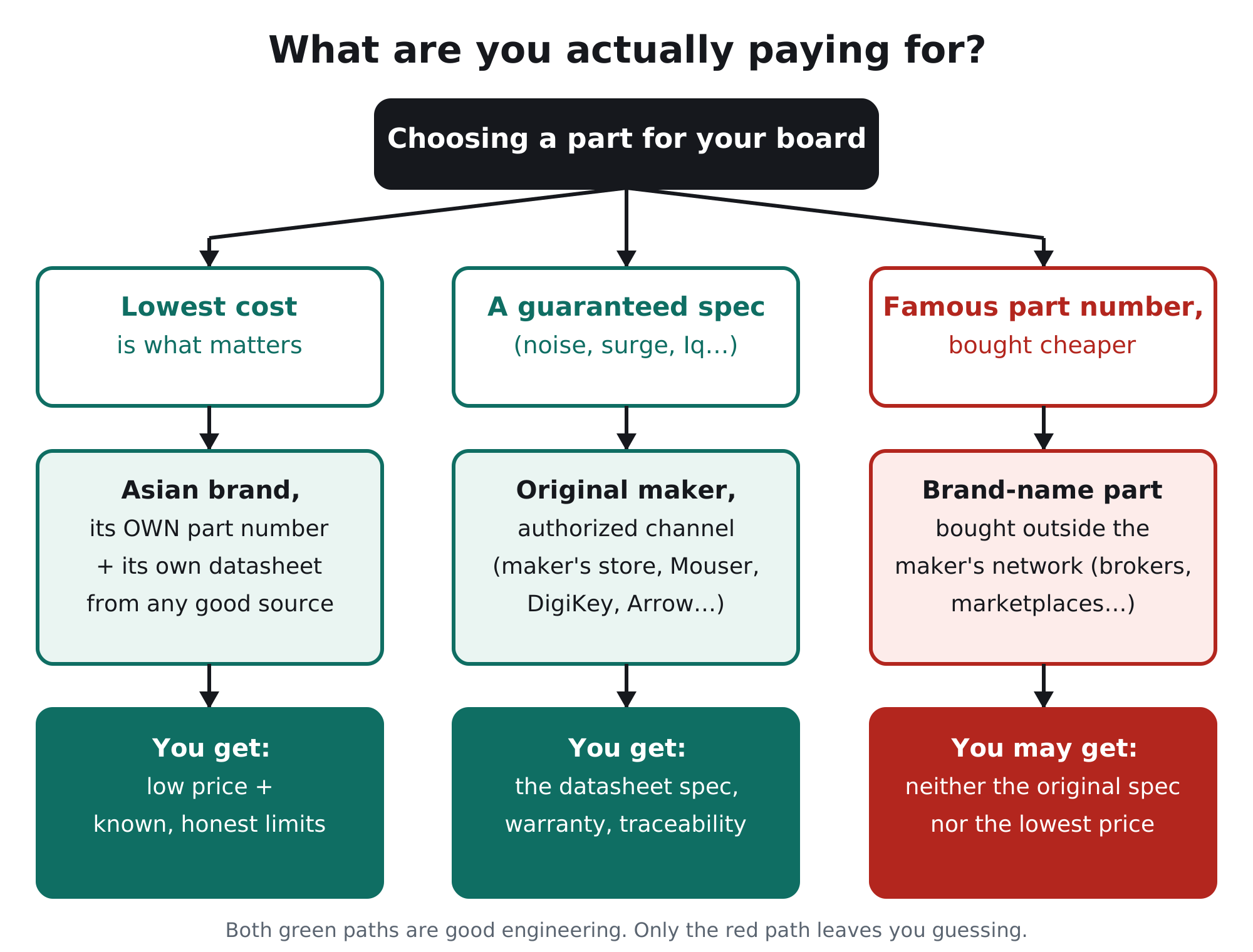
- Decide which spec you are paying forWrite down the one or two numbers that made you choose the part: noise, surge current, sleep current, saturation current, dielectric. If none of them matters, you don’t need the premium part.
- If cost wins, buy honestly cheapChoose an Asian brand under its own part number, read its datasheet, and design to its limits. LCSC is excellent for this. A ₹2 LDO you understand beats a “₹7 TI” that isn’t.
- If the spec wins, buy from the authorized channelBuy from the maker’s own store or its authorized distributors. For TI that means TI.com, Arrow, DigiKey or Mouser; ADI, ST, Microchip, Samsung and every other major maker publish their own lists. Do the same for passives. Keep the invoice and the reel label. You pay a little more, and you get what you paid for.
9. Why Ramanu uses only genuine parts
We started Ramanu Systems in Pune to build precision modules in India that people can trust, with published engineering data behind every claim. Everything in this article is why we work the way we do:
- Genuine chips from TI and other makers, bought through authorized channels, with the invoice kept
- Branded Samsung capacitors, chosen from their DC-bias curves
- Bare PCBs from the fab; we buy, fit and test the parts ourselves
- No unbranded passives, and no “equivalent” substitutions
- Specs on our product pages come from the datasheet or our own bench
- If we can’t verify something, we say so
Our modules cost more than the cheapest ones on the market, and this article shows you why. We deliver what you pay for.
The 7 µV you actually paid for
TrueVolt LN-7A2033 · Genuine TI TPS7A2033
Clean 3.3 V for sensors, ADCs, radios and audio. Built on the genuine TI part, with Samsung capacitors chosen for their real value at the operating voltage.
- 7 µVrms noise, 95 dB PSRR at 1 kHz, 300 mA (TI datasheet)
- Genuine TI and Samsung parts, sourced from authorized channels
- Designed, assembled and tested in Pune, India
For engineers: what you can and can’t verify
1. Datasheet red flags (free, takes five minutes)
| Red flag | Example from this article |
|---|---|
| Key specs only “typ”, at 25 °C, with no max | TSD05DYFR-TP clamp at 18 A; MSTPS7A2033 dropout |
| Numbers that don’t agree with each other | 350 W listed vs 18 A × 16 V = 288 W |
| A table that disagrees with its own graph | TDSEMIC L7805: IQ 5 mA typ in the table, 2–3 mA in the graph |
| Another company’s name left in a drawing | “UTC” on the TDSEMIC L7805 application circuit |
| Marking codes identical to the famous original | MSKSEMI’s 2AUF / 2AXF / 2AZF / 2B1F = TI’s codes |
| Missing sections: ESD rating, current limit, curves | MSTPS7A2033: no current limit or ESD rating |
| Passives with only value and tolerance | No DC-bias curve, no TCR, no saturation current |
2. Checks you can do at home
- Capacitor at its working voltage. Charge it from a constant current and time the voltage rise across your operating point. C = I × Δt / ΔV. For example, 1 mA and 0.42 ms to go from 3.0 to 3.6 V gives 0.7 µF at about 3.3 V. Compare that with the maker’s DC-bias curve (how DC bias works). Test 3–5 pieces from each new reel.
- Inductor saturation. Run the inductor in your converter at full load, then look at its current ramp with a current probe or a small shunt. A straight ramp is fine. A ramp that bends sharply upward at the peak means it is saturating. Repeat after it has warmed up.
- TVS breakdown and leakage. A current-limited supply at 1 mA for VBR, a µA meter at VRWM. This only catches gross mismatches; a weaker part passes too.
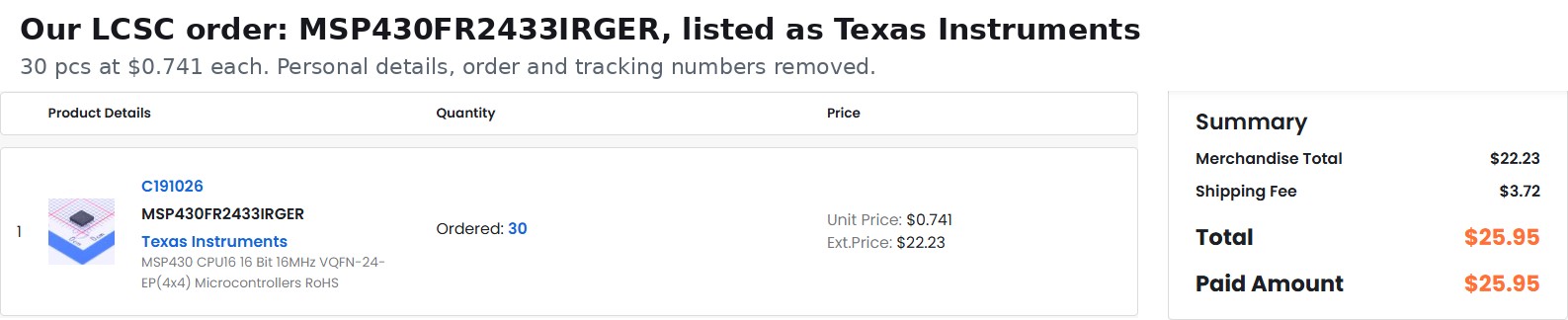
- MCU sleep current. A µA meter or a current-sense setup, measuring over minutes, not seconds. Our MSP430 problem was periodic, not constant.
3. What needs a lab
| Spec | Equipment |
|---|---|
| LDO noise at the 7 µV level | Low-noise amplifier, shielding, spectrum analysis |
| TVS surge rating (8/20 µs) | IEC 61000-4-5 surge generator. The test destroys the part, so you can only test samples, never the parts you ship. |
| ESD robustness | IEC 61000-4-2 ESD gun |
| Capacitor dielectric over temperature | LCR meter with DC bias, plus a temperature chamber |
| Resistor sulfur resistance, long-term drift | Environmental chamber, hundreds to thousands of hours |
| What silicon is inside | Decapsulation and die inspection |
Frequently asked questions
Is LCSC genuine?
LCSC states that all parts it sells are original and authentic, and it lists alternative brands under their real maker names. We have no evidence that LCSC sells counterfeits. But LCSC is not on the authorized-distributor lists of TI or ADI, and TI gives no warranty or support for TI parts bought outside its authorized network. Some alternatives listed on LCSC also share a famous part-number stem and top marking while having weaker specs.
Are LCSC parts fake?
Parts listed under their own Asian brand names are not fakes: they are what the listing says, made to their own datasheets. The risk is different. Some of them share a famous part number stem and marking, so once they leave the reel they can be passed off as the original by someone else. And any famous-brand part bought outside the maker’s authorized network comes without that maker’s guarantee.
Is it safe to buy from LCSC?
For honestly branded parts used within their own datasheet limits, for connectors and for prototypes, yes, it is widely used and good value. For a part you chose for one guaranteed spec, such as low noise, surge rating or sleep current, buy from the maker or its authorized distributor.
Is LCSC an authorized distributor for TI or ADI?
Not according to the makers’ own pages, as of October 2026. TI’s distributor page lists Arrow, DigiKey, Mouser and, for Japan, Macnica and Tokyo Electron Device; TI.com also sells directly, including to India. ADI’s authorized-distributor page did not list LCSC either. Always check the maker’s own list, because it can change.
Are cheap capacitors, resistors and inductors OK to use?
Only where their real behaviour doesn’t matter. Passives carry no marking, so you can’t verify them, and the important specs aren’t printed on the part: a capacitor’s DC-bias derating and dielectric, a resistor’s temperature coefficient and pulse rating, an inductor’s saturation current when hot. Branded parts publish these curves. For anything in a power path, filter, timing or protection circuit, buy branded passives from an authorized distributor.
Why would a cheap chip work but still be bad?
Because “working” and “meeting the datasheet” are different. A chip that fails one test limit, such as noise, sleep current or temperature range, usually still powers up and runs. Such parts are supposed to be destroyed. When they leak into the market, or when a different design is sold under the same part number, they pass basic checks but miss the one spec you chose the part for.
How can I tell if a TPS7A2033 is genuine?
From the outside, you usually can’t. TI’s TPS7A2033PDBVR is marked 2AZF, and at least two alternatives listed on LCSC carry the same 2AZF marking and give the correct 3.3 V. The difference is in noise (7 vs 70 µVrms) and PSRR, which need a low-noise measurement setup. Buy from TI or an authorized distributor and keep the invoice.
Is TSD05DYFR-TP the same as TI TSD05DYFR?
No. TI’s TSD05 is rated for 60 A (8/20 µs), 529 W, 5.5 V working voltage and 19 pF. TECH PUBLIC’s TSD05DYFR-TP is rated for 18 A, 350 W, 5.0 V and 1 pF. They are different kinds of protection diode and are not drop-in replacements.
Why are ADXL345 modules cheaper than the ADXL345 chip?
Because the chip on a cheap module is very unlikely to have come through Analog Devices’ normal channel. LCSC sells the genuine ADXL345 at about $5–7 each in small quantities, roughly ₹300 or more. A complete module selling for about ₹250 leaves very little room for a genuine chip bought through the normal channel.
Where can I buy genuine TI or ADI parts in India?
From the maker or its authorized distributors. TI sells directly on TI.com, with prices in rupees, and lists Arrow, DigiKey and Mouser as authorized distributors. ADI publishes its own list of authorized distributors on analog.com. Keep the invoice.
How do I check if a distributor is authorized?
Look for the distributor on the chip maker’s own website, not on the distributor’s site. TI, ADI, ST, Microchip, Samsung and other major makers each publish a list of authorized distributors. If the seller isn’t on that list, the maker may not support or warranty the part.
Get what you paid for
Genuine parts, published data, made in India
Every Ramanu module is built on genuine chips and branded passives, bought from authorized channels. Cheaper than one failed product in the field.