TrueVolt LN-7A2033 · Clean power for sensors, radios & audio
Works on battery, fails on a charger? Fix it in 2 minutes with 3 wires.
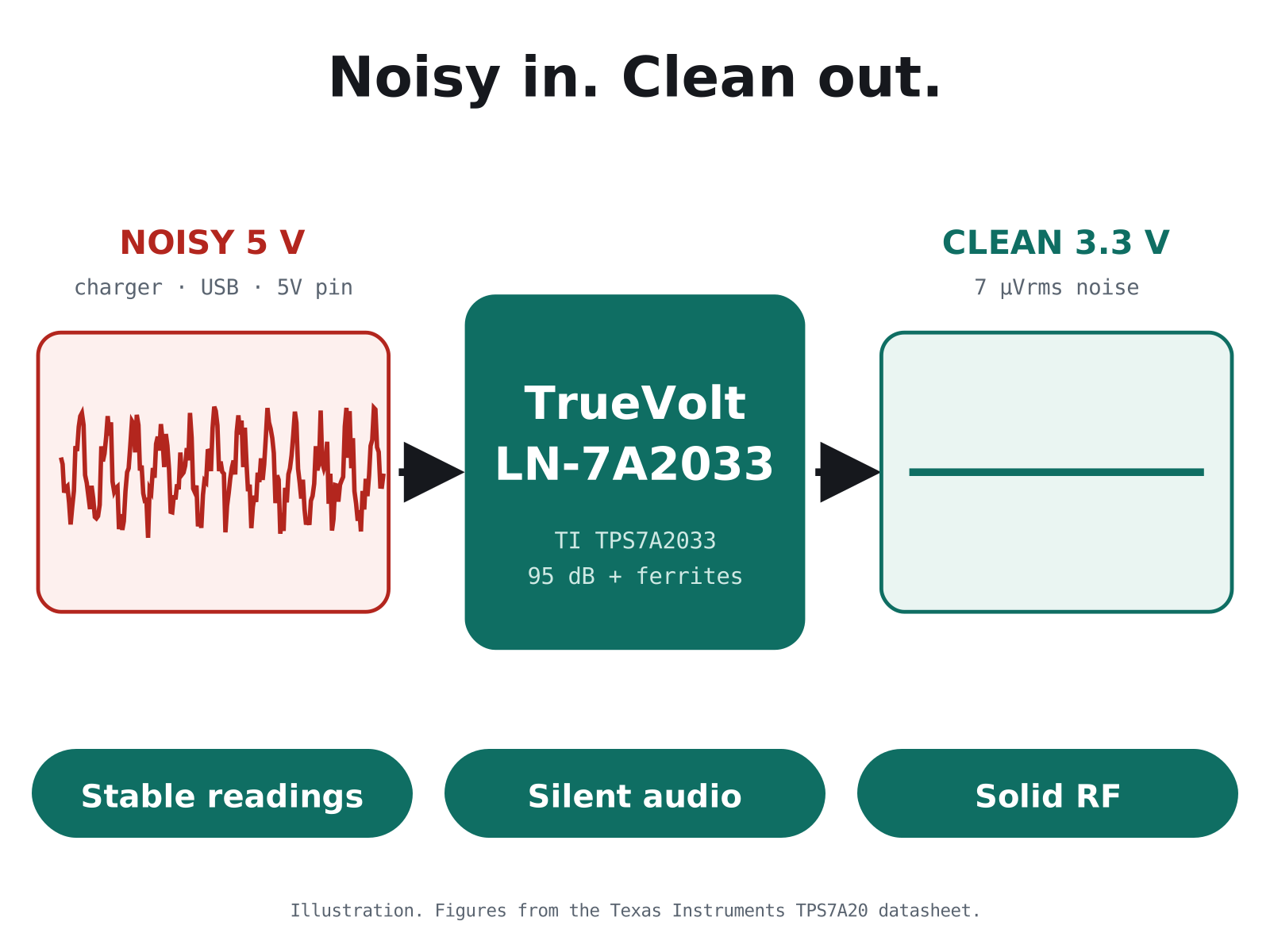
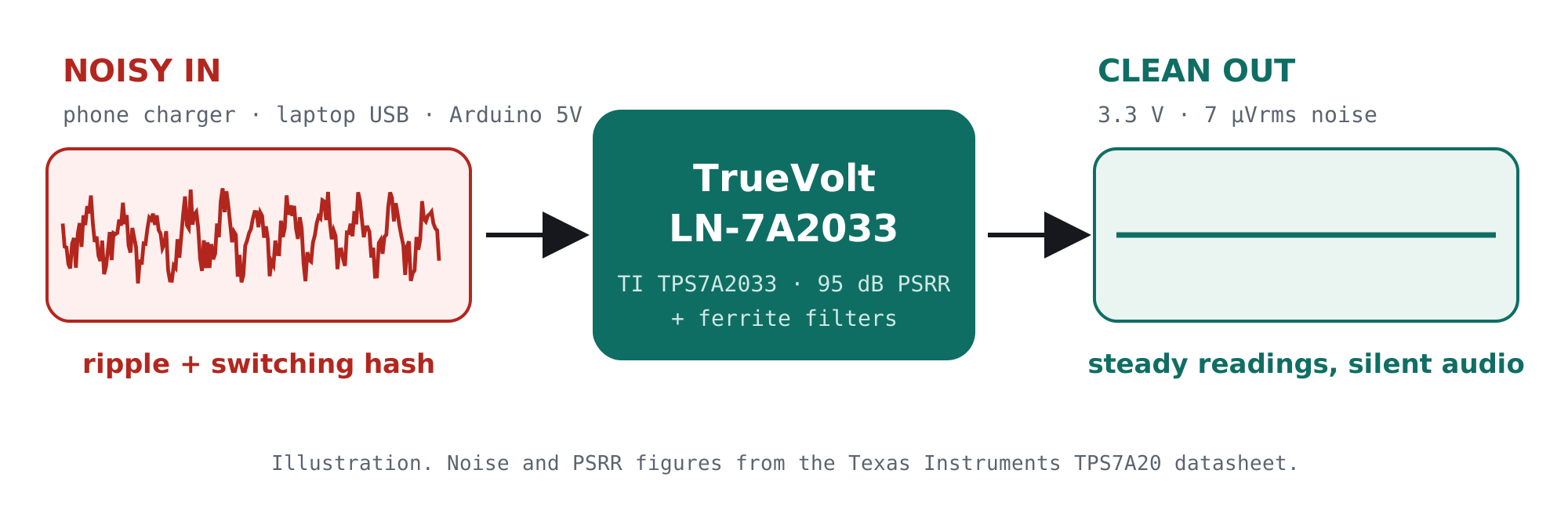
That’s power-supply noise. Put this module between your 5 V and the sensitive part: it turns noisy USB or charger power into a quiet, steady 3.3 V, so readings stay stable, audio stays silent and radios stay connected.
Cheaper than one failed demo.
Fixes the problems makers hit every day
If it works on batteries but misbehaves on a charger or USB, the supply is the suspect.
⚖️ Weight keeps jumping
HX711, NAU7802, ADS1232 load-cell scales
Fixed: steady weight, tare that holds
🎤 Microphone hiss & spikes
MAX4466, MAX9814 sound modules
Fixed: quiet background, no false triggers
📡 Radio drops packets
NRF24L01, including PA+LNA version
Fixed: stable 3.3 V with current to spare
🛰️ GPS won’t get a fix
NEO-6M and similar modules on switching power
Fixed: the quiet supply GPS makers ask for
📈 ADC readings wander
ESP32 / Arduino analogRead, ADS1115, pH and pressure sensors
Fixed: clean sensor supply and reference
🎵 Audio buzz & noisy ECG
PCM5102 DAC modules, AD8232 ECG boards
Fixed: silent background, cleaner trace
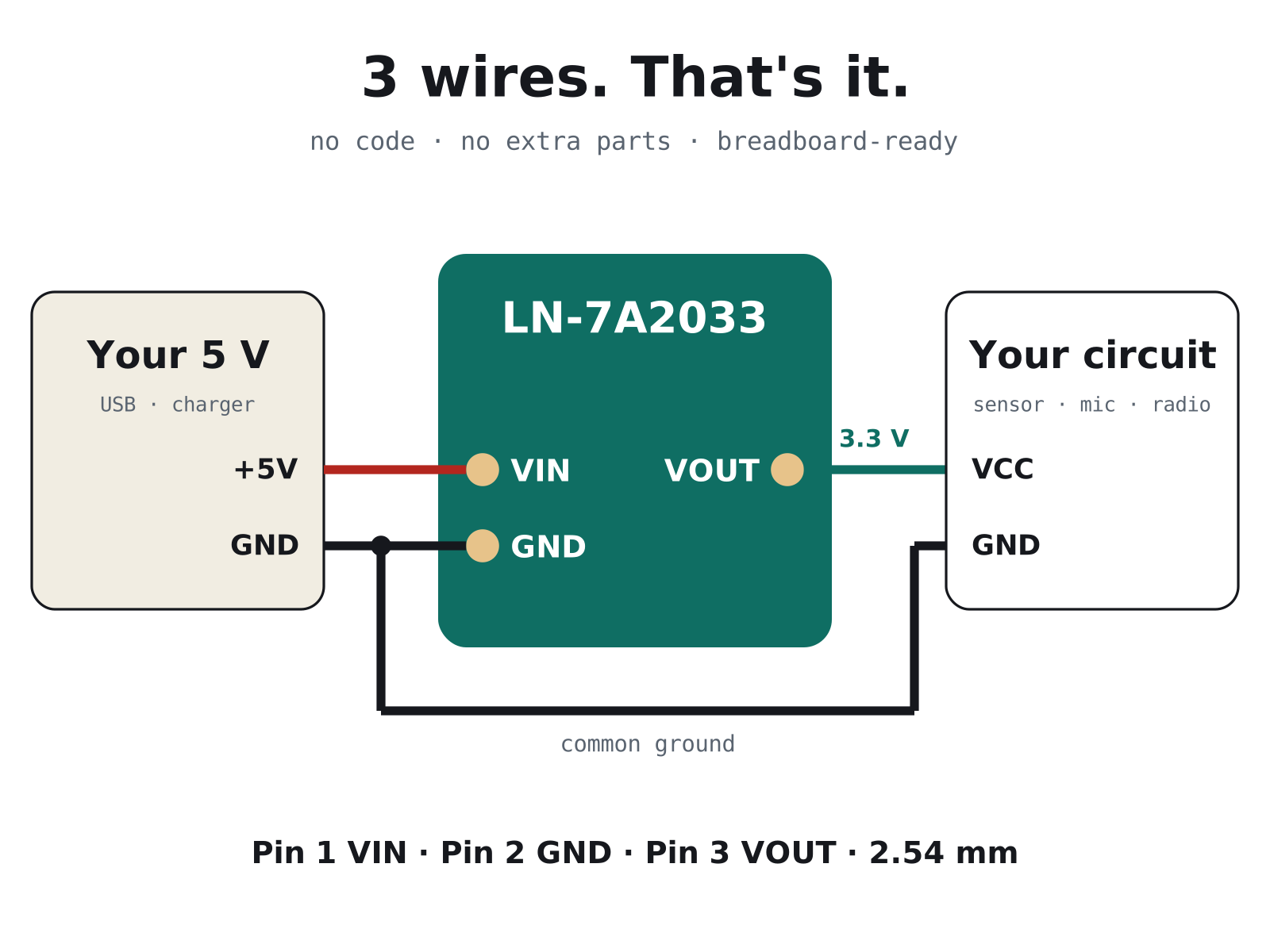
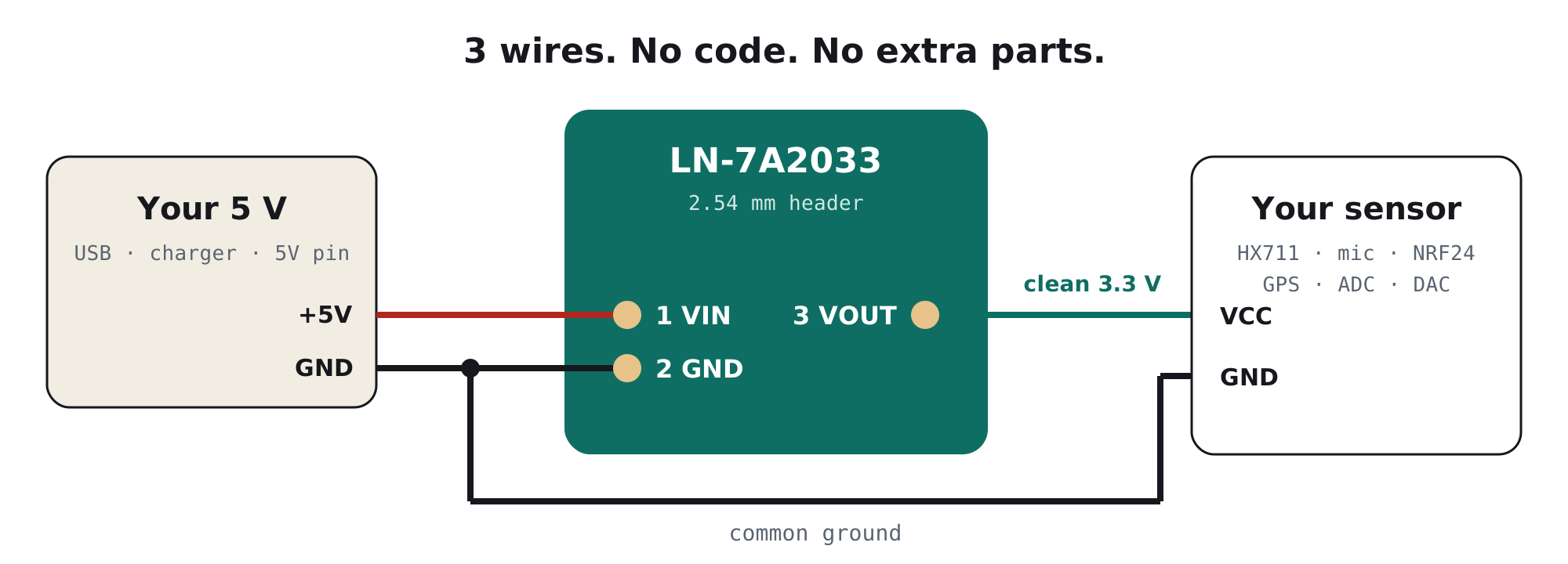
Connect it in a minute
What noise is really costing you
Cheaper than one failed demo.
A scale that drifts or a radio that drops on submission day costs far more than the fix.
Before you buy a 24-bit ADC, fix the rail.
On a noisy 3.3 V, a 24-bit ADC gives about 8 usable bits. A quiet rail gives you the bits you paid for.
Cheaper than an evening of debugging.
Stop rewriting filters in code for noise that comes from the supply.
Already have an AMS1117 board?
It’s fine for powering a microcontroller. It was never designed for clean power.
| What matters | AMS1117-3.3 | TrueVolt LN-7A2033 |
|---|---|---|
| Output noise | ≈100 µV (0.003% of Vout, 10 Hz–10 kHz) | 7 µVrms, over a wider 10 Hz–100 kHz band |
| Ripple rejection | ≈75 dB at 120 Hz | 95 dB at 1 kHz, plus ferrite filters for MHz noise |
| Dropout | ≈1.1 V: a sagging USB rail drags 3.3 V down | 140 mV at 300 mA (regulator) |
| Standby current | ≈5 mA | 6.5 µA (LED switched off): good for batteries |
| Protection | Usually none | Input and output Schottky diodes |
| Parts source | Unknown | Genuine TI, authorised distribution |
Typical values from the AMS1117 and Texas Instruments TPS7A20 datasheets.
What’s on the board, and why
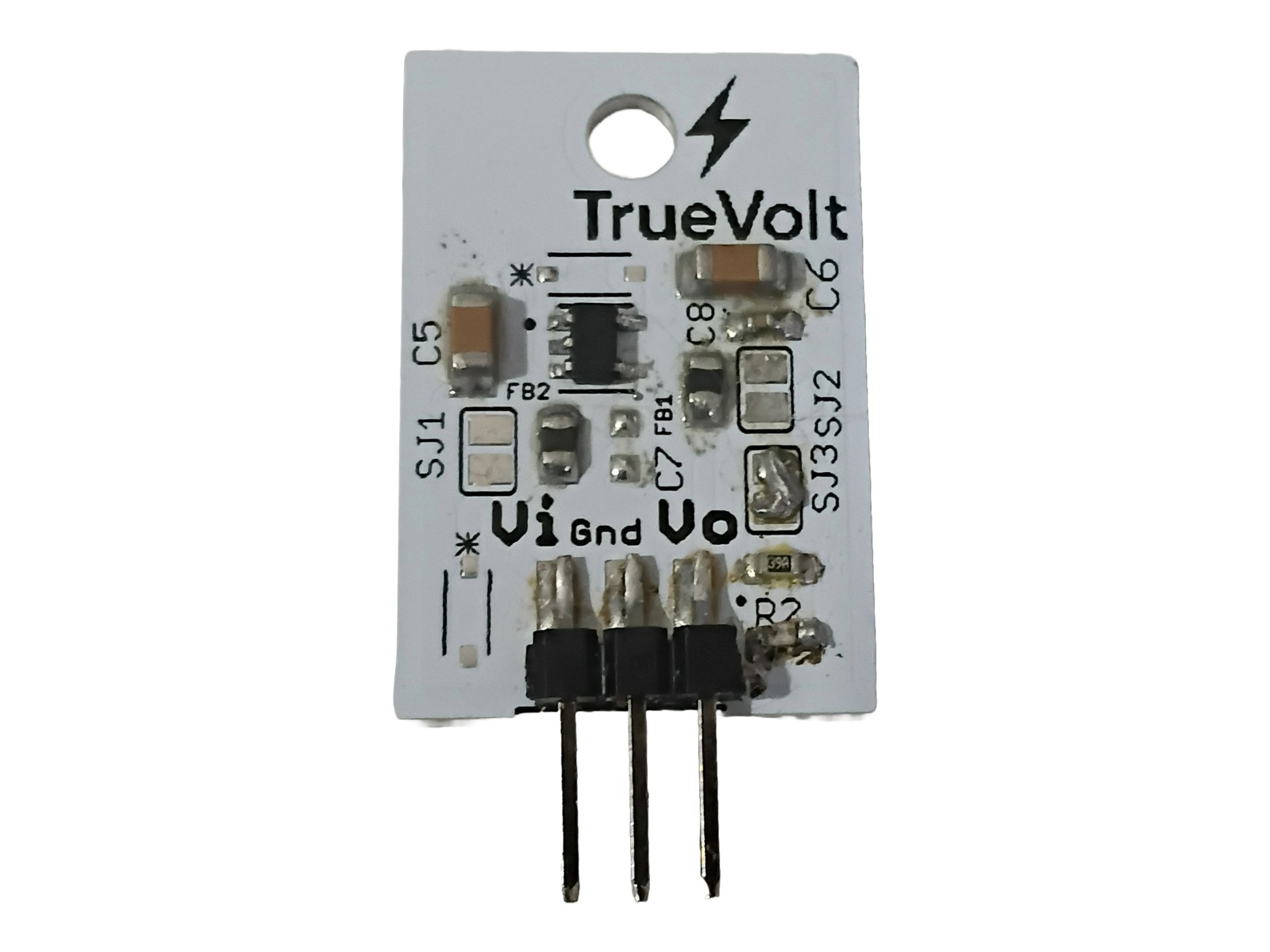
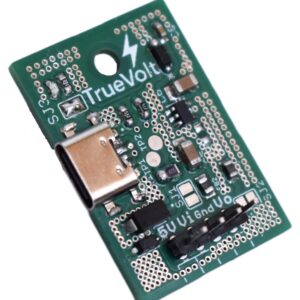
Genuine TI TPS7A2033
Ultra-low-noise LDO, bought through authorised distribution. No relabelled or clone chips.
Ferrite noise filters
MPZ2012S331A beads (330 Ω at 100 MHz) catch the high-frequency charger hash that an LDO alone can’t reject. Input bead active as shipped; output bead optional.
Dual Schottky protection
Input diode guards against reverse wiring and hot-plug spikes; output diode stops backflow at power-down.
Samsung 1206 capacitors
Keep about 8.7 µF of real capacitance at 5 V, where a cheap 0603 drops near 2 µF. Why it matters →
Aluminium PCB
Spreads heat far better than FR4, so the regulator runs cooler at full load. See the thermal test →
Configurable with jumpers
SJ1 bypasses the input ferrite for low-headroom inputs; SJ2 lets you add output filtering; the LED jumper enables 6.5 µA battery mode.
Set it up for your circuit
| Setting | Jumpers | When to use it |
|---|---|---|
| As shipped (recommended) | SJ1 open · SJ2 shorted | Most projects. Input ferrite filters charger and USB noise; output ferrite is bypassed for the lowest output impedance and no ringing. |
| Low input voltage | Short SJ1 | Input close to 3.3 V (for example a single Li-ion cell). Bypasses the input ferrite so its voltage drop doesn’t eat the regulator’s headroom. |
| Extra output filtering | Open SJ2 (desolder) | RF-sensitive loads that need more high-frequency filtering. A ferrite with output capacitance can ring, so check your rail with your actual load. |
| Battery mode | Open the LED jumper | Switches off the power LED; standby drops to 6.5 µA. |
Fix guides: is this your problem?
Step-by-step troubleshooting with a 2-minute test, wiring diagrams and FAQs.
Which Ramanu module do you need?
General 3.3 V power
TrueVolt74033
TI TLV740P. For powering microcontrollers and everyday IoT boards on a budget.
View →You are here · Clean power
TrueVolt LN-7A2033
For anything noise-sensitive: load cells, ADCs, mics, radios, GPS, audio.
Add to cart →USB-C, 5 V + quiet 3.3 V
PureRail C33 Nano
Same quiet 3.3 V regulator plus filtered 5 V, straight from a USB-C charger.
View →Full technical specifications
| Regulator | Texas Instruments TPS7A2033 (genuine) |
| Output | 3.3 V fixed, ±1.5%, up to 300 mA |
| Output noise | 7 µVrms (10 Hz–100 kHz) |
| PSRR | 95 dB at 1 kHz · 40 dB at 1 MHz |
| Dropout (regulator) | 140 mV at 300 mA |
| Input | 5 V typical (USB, charger, 5 V pin); up to 6.0 V (6.5 V absolute max, never operate there) |
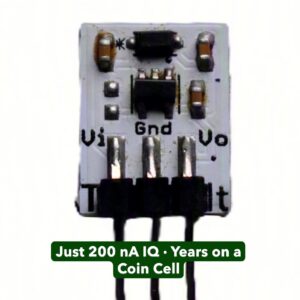
| Quiescent current | 6.5 µA typical (LED jumper open) |
| Shutdown current | 0.1 µA (EN low) |
| EMI filter | 2× MPZ2012S331A ferrite beads, 330 Ω at 100 MHz: input bead active, output bead bypassed by SJ2 as shipped |
| Protection | CR2 input Schottky (reverse polarity, transients) · CR1 output Schottky (backflow) |
| Capacitors | Samsung CL31A106KAHNNNE, 10 µF X5R 25 V 1206 (C5, C6) |
| Configuration | SJ1 input-ferrite bypass (open as shipped) · SJ2 output-ferrite bypass (shorted as shipped) · LED solder jumper |
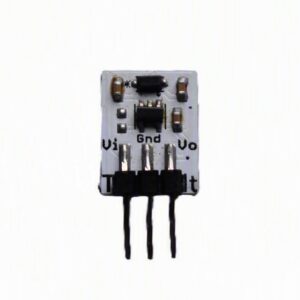
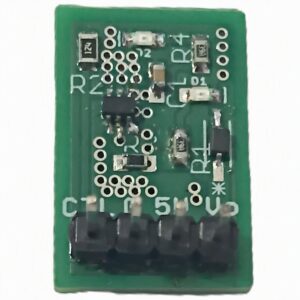
| Pinout | 1: VIN · 2: GND · 3: VOUT, 2.54 mm pitch |
| Board | Aluminium MCPCB, 18 × 27 mm |
| Operating temperature | −40 °C to +125 °C (regulator junction) |
Proof, not promises
Everything we claim, you can check.
Cheaper than one failed demo.
Works on battery, fails on a charger? Fix it in 2 minutes with 3 wires.
Add TrueVolt LN-7A2033 to cart → Buy nowDesigning with the chip itself?
TPS7A20 datasheet explained: specs, pinout & application circuit →
Reviews
There are no reviews yet.