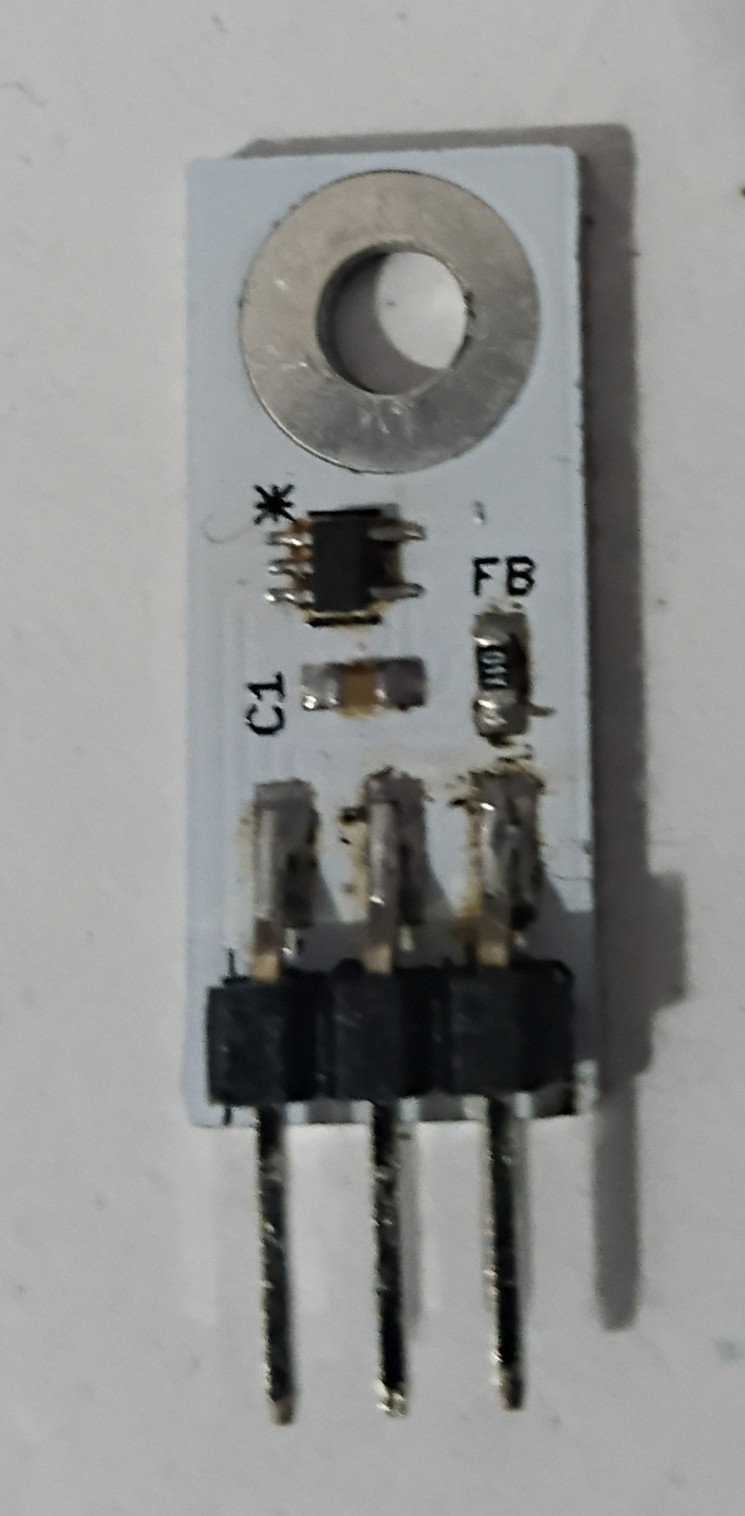
Temperature Sensing Made Simple, Fast, and Accurate
The SwiftSense T235 strips temperature sensing down to its simplest form: connect VCC, GND, and read the analog output. No I2C bus, no protocol libraries, no address conflicts. Just a clean 10mV-per-degree-Celsius linear voltage that any ADC pin can read directly.
Built on the genuine Texas Instruments TMP235 A2 silicon with an aluminum MCPCB substrate, this module responds 2× faster than equivalent FR4-based sensors — critical for applications where thermal events happen quickly, like 3D printer hot-end protection, motor winding monitoring, or battery pack thermal management.
Key Specifications
| Sensor IC | Texas Instruments TMP235 A2 (genuine, authorized distribution) |
| Accuracy | ±0.5°C (0°C to 70°C) · ±2°C (-40°C to +150°C full range) |
| Output Type | Analog linear — 10mV/°C with 500mV offset at 0°C |
| Temperature Range | -40°C to +150°C |
| Supply Voltage | 2.3V to 5.5V |
| Quiescent Current | 9 µA typical — ideal for multi-year battery operation |
| PCB Material | Aluminum MCPCB (1.0–3.0 W/m·K) — 2× faster thermal response vs FR4 |
| Thermal Response (τ) | 7.4 seconds to 63% of target temperature (aluminum, dry mount) |
| Stabilized Reading | 88.2°C from 90°C source — within 2°C accuracy (dry mount, no thermal grease) |
| EMI Filter | Murata ferrite bead for noise suppression |
| Decoupling | Samsung MLCC capacitor for power stability |
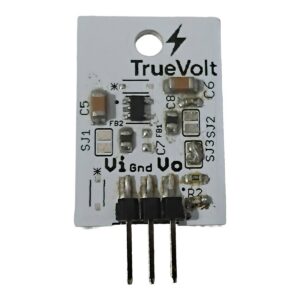
| Module Dimensions | 22.0 mm × 9.5 mm |
| Mounting | Pre-drilled 3.4mm hole for M3 clearance — secure mechanical + thermal contact |
| Pin Pitch | 2.54 mm (breadboard compatible) |
| Pinout | Pin 1: Vcc · Pin 2: Gnd · Pin 3: Vo (analog output) |
| Max Continuous Operation | 130°C (24/7 industrial deployment) |
| Peak Exposure | 150°C (intermittent measurements) |
| Interface | Pure analog — no I2C, no SPI, no libraries required |
The Aluminum PCB Advantage — Tested & Proven
Standard FR4 PCB acts as a thermal insulator between the sensor IC and the surface you’re measuring. Our aluminum MCPCB conducts heat 8–12× faster than FR4, delivering a thermal response that’s 2× faster.
In controlled testing, the SwiftSense T235 on aluminum reached 88.2°C from a 90°C source in 35 seconds — while an identical sensor on FR4 reached only 64.1°C. That’s a 24°C measurement gap from the same heat source. For thermal protection applications, this speed difference is the margin between catching a thermal runaway and missing it.
Read the full experiment: Aluminum PCB vs FR4 — Temperature Sensor Thermal Response Test
Simple Temperature Calculation
Reading temperature is one line of math:
Temperature (°C) = (Output Voltage in mV − 500) ÷ 10
At 25°C, the output is 750mV. At 100°C, it’s 1500mV. Linear, predictable, no lookup tables needed for the 0–100°C range. Above 120°C, a piecewise correction improves accuracy to within ±2°C at 150°C — full correction table included in the datasheet.
Thermal Design Optimization
The PCB is engineered with sufficient extra free area around the sensor, specifically designed to act as a heat-spreader. The completely flat aluminum bottom layer ensures maximum surface contact when mounted against a target surface. Apply thermal grease for optimal results, or use dry-mount for quick deployment — the aluminum substrate performs well in both scenarios.
High-temperature tip: For applications above 130°C, remove the plastic header connector and directly solder silicone-insulated wires to the pads. Silicone wire withstands much higher temperatures without degradation.
Ideal Applications
- BMS & Battery Packs — instant detection of hot spots in lithium cells to prevent thermal runaway
- Industrial Motors & Pumps — overheat protection with fast response on motor casings
- 3D Printer Monitoring — hot-end, heated bed, and chamber temperature with real-time tracking
- Power Electronics — monitoring MOSFET and transformer temperatures
- IoT Wireless Nodes — 9µA quiescent current enables multi-year battery operation
- HVAC & Environmental — high-accuracy climate monitoring
- Arduino & ESP32 Projects — direct ADC connection, no libraries needed
Why Silicon Analog Beats NTC
| Parameter | Standard NTC | SwiftSense T235 (TMP235) |
|---|---|---|
| Linearity | Exponential — needs complex math | Linear 10mV/°C — simple division |
| Tolerance | 1–5% (hobbyist grade) | ±0.5°C (calibrated silicon) |
| Thermal Safety | NTC resistance drops with heat — runaway risk | PTC-like behavior — self-limiting, inherently safer |
| Interchangeability | Low — each unit varies | High — factory calibrated, consistent unit-to-unit |
| Software Complexity | Steinhart-Hart equation, large lookup tables | One-line formula: (mV − 500) ÷ 10 |
Authenticity Guarantee
Every SwiftSense T235 is built with genuine components from authorized distributors: Texas Instruments TMP235 A2 analog sensor, Murata ferrite bead, and Samsung MLCC capacitor. All components rated to work at +150°C. No generic substitutes.
Designed & Made in India
Engineered and assembled by Ramanu Systems, Pune, Maharashtra. Every module tested before dispatch.
Reviews
There are no reviews yet.