Guide · Power-supply noise · Arduino · ESP32 · Raspberry Pi Pico
Works on Battery, Fails on a Charger? The Power-Supply Noise Guide
Works on battery but not on a charger? The same circuit and code behave like two different projects:
That difference has a name: power-supply noise. This guide shows how to confirm it in 2 minutes and how to fix it for good.
Ramanu Systems · Pune, India · 4-minute answer, 12-minute deep dive
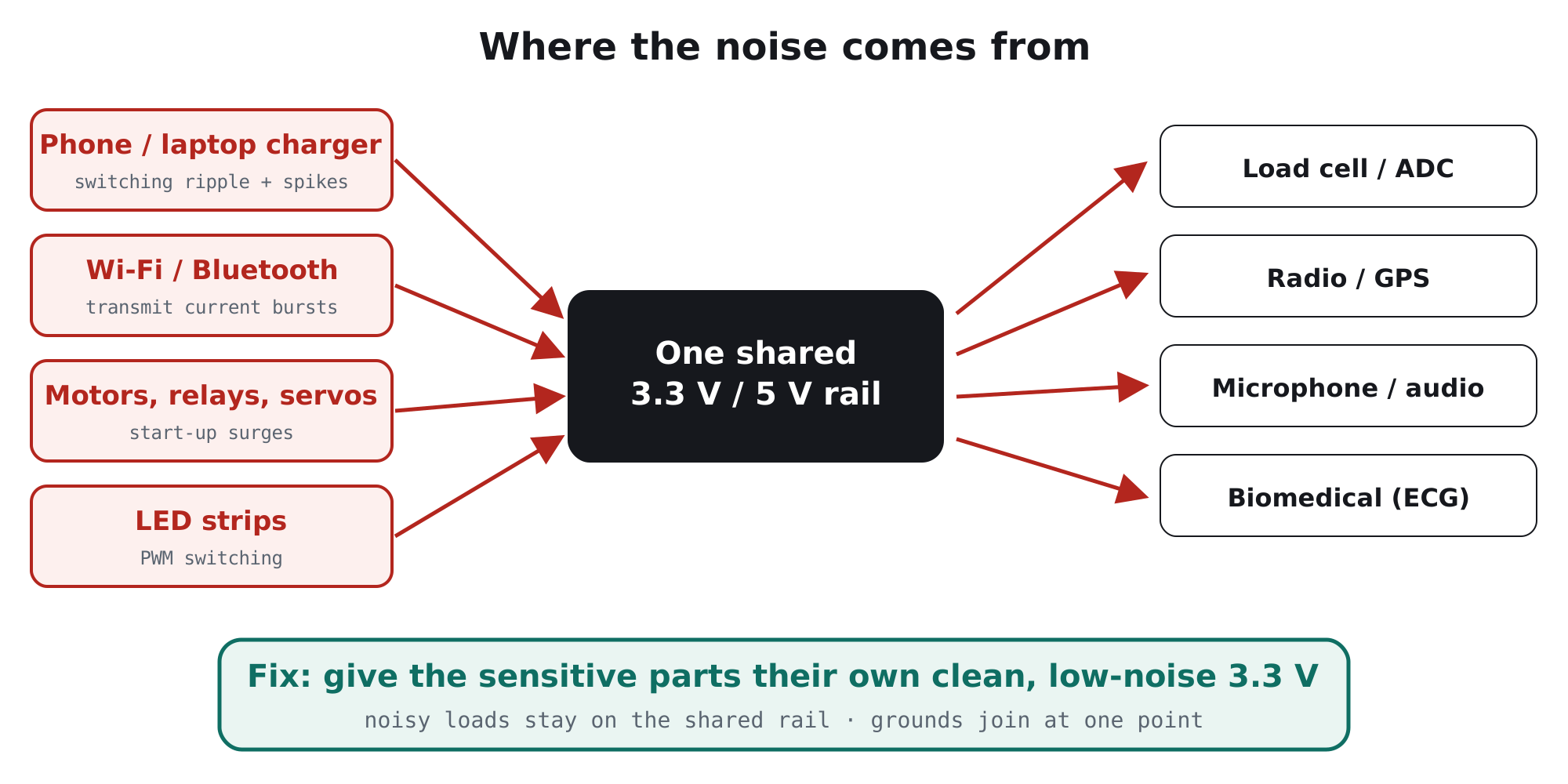
Batteries give clean, steady power. Phone chargers, laptop USB ports and power banks are switching supplies that add ripple and spikes. On top of that, Wi-Fi, motors and LED strips on the same rail add their own current bursts. Sensors, radios and microphones are sensitive enough to pick this up.
Fix: give the sensitive parts their own clean, low-noise 3.3 V supply, and keep the noisy loads on the main rail.
Find my symptom ↓ Run the 2-minute testFind your symptom
Pick the card that matches your project. Each one goes to a detailed fix.
Where the noise comes from
Most hobby projects run everything from one rail: the board’s 5 V or 3.3 V pin. The noisiest parts and the most sensitive parts end up sharing the same wire.
| Noise source | What it does to the rail |
|---|---|
| Phone and laptop chargers | Switching converters leave ripple and fast spikes on the 5 V output, and the quality varies a lot between chargers. |
| Wi-Fi and Bluetooth | The ESP32 draws short bursts of up to about 500 mA while transmitting, which pull the rail down. |
| Motors, relays, servos | Large surges when they start, plus brush and switching noise while running. |
| LED strips | PWM dimming switches large currents on and off hundreds of times a second. |
The 2-minute test
Before you change anything else, confirm the supply is the problem. Batteries are electrically quiet, so they make the perfect reference.
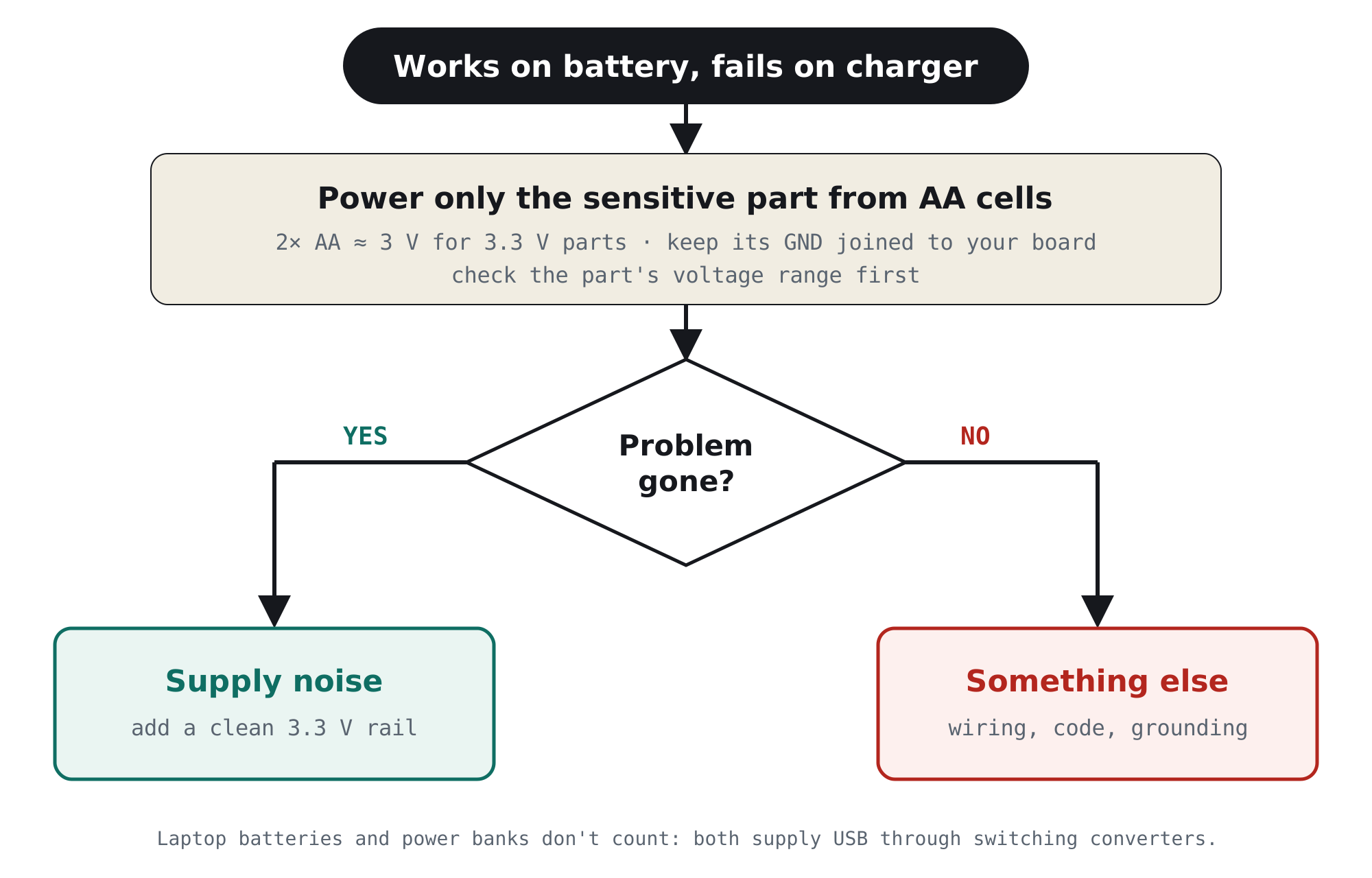
The fix: separate quiet power from noisy power
The clean rail we designed for this
TrueVolt LN-7A2033 · Clean power for sensors, radios & audio
Put it between any 5 V source and your sensitive parts. Three pins, no code.
- 7 µVrms noise and 95 dB ripple rejection at 1 kHz (genuine TI TPS7A2033)
- 300 mA: sensors, radios, GPS, mics and ADCs together
- Ferrite filtering, Samsung 1206 capacitors, aluminium PCB
- Reverse-polarity and reverse-current protection
- Designed & made in Pune, India
For engineers: choosing a supply for sensitive circuits
| Supply option | Noise on output | Strengths | Weak points |
|---|---|---|---|
| Board 3.3 V pin | Whatever the board’s regulator and loads add | Already there | Shared with the MCU and radio; limited current (about 50 mA on an Uno) |
| AMS1117 module | ≈100 µV (10 Hz–10 kHz) | Cheap, 800 mA | ≈1.1 V dropout, ~5 mA quiescent, modest ripple rejection |
| Buck converter module | Switching ripple, often tens of mV | Efficient at high current | The noisiest option for sensors unless followed by an LDO |
| Batteries | Very low | Quiet, isolated | Voltage falls as they discharge; they run out |
| Low-noise LDO (TPS7A2033) | 7 µVrms (10 Hz–100 kHz) | 95 dB PSRR at 1 kHz, 140 mV dropout | 300 mA limit; dissipates (Vin−3.3 V)×I as heat |
For high-current systems, the common professional pattern is a buck converter for efficiency followed by a low-noise LDO for the sensitive rail. The buck does the bulk conversion; the LDO cleans up what’s left.
What PSRR means in practice
Power-supply rejection ratio is how much of the input noise a regulator blocks. 95 dB means ripple at 1 kHz is reduced about 56,000 times. PSRR falls at higher frequencies for every LDO, which is why good modules add ferrite beads to catch the MHz switching hash from chargers.
Frequently asked questions
Why does my Arduino project work on battery but not on a charger?
Batteries give clean DC, while phone chargers and laptop USB ports are switching supplies that add ripple and spikes. Sensitive parts like load cells, radios and microphones pick up that noise. Power them from a dedicated low-noise 3.3 V regulator and keep noisy loads on a separate rail.
Is laptop USB power noisy?
It can be. Laptop USB power passes through the laptop’s own switching converters and shares ground with everything inside, and it changes when the laptop’s charger is plugged in. Many makers see their readings change when the laptop starts charging.
Are phone chargers bad for electronics projects?
They are fine for powering microcontrollers, but their output ripple and switching spikes vary widely between brands. For sensitive analog, radio or audio parts, add a low-noise linear regulator after the charger.
Will a capacitor fix power-supply noise?
A capacitor helps with short spikes and current bursts, but it does little against low-frequency ripple or a weak, current-limited source. A low-noise regulator plus a local capacitor handles both.
Should I use a buck converter or an LDO for sensors?
An LDO for the sensitive parts. A buck converter is efficient but leaves switching ripple. For high-current systems, use a buck converter followed by a low-noise LDO.
Is the AMS1117 a low-noise regulator?
No. It’s a general-purpose regulator, fine for powering microcontrollers. Its datasheet output noise is around 100 µV and its dropout is about 1.1 V, while a dedicated low-noise LDO like the TPS7A2033 is specified at 7 µVrms with 140 mV dropout.
What is the best power supply for noise-sensitive sensors?
A dedicated low-noise 3.3 V linear regulator, fed from 5 V and used only for the sensitive parts. For example, the Ramanu TrueVolt LN-7A2033 (TI TPS7A2033, 7 µVrms, 95 dB PSRR at 1 kHz, 300 mA) turns noisy USB or charger power into a clean rail for sensors, radios and microphones.
Fix it today
Make your project work on any charger
One small module, genuine TI inside, made in India. Cheaper than one failed demo.