Datasheet explained · Texas Instruments · Analog temperature sensor
TMP235 Datasheet Explained: Specs, Pinout, Formula & Circuit
The TMP235 datasheet gives you a voltage that rises 10 mV for every degree. Here’s the formula, working code, both pinouts, the one ADC rule people miss, and how it compares with the LM35.
Ramanu Systems · Pune, India · Based on TI datasheet SBOS857E
The TMP235 is an analog temperature sensor from Texas Instruments. Power it from 2.3 to 5.5 V and its output is 500 mV at 0 °C, rising 10 mV per °C. No I²C, no library: connect the output to any ADC pin. It works on 3.3 V boards like the ESP32, which the LM35 can’t.
T = (mV − 500) ÷ 10Is the TMP235 right for your design?
It’s a good fit if:
- You want a temperature reading on any ADC, with no library
- Your board runs on 3.3 V (ESP32, Pico, STM32)
- You need to read below 0 °C on a single supply
- Battery life matters (9 µA)
- You’re replacing an LM35 or TMP36
- You need up to 150 °C
Look elsewhere if:
- You need better than about ±1 °C guaranteed
- The sensor sits at the end of a long cable (use a digital sensor)
- Your ADC is too noisy to resolve millivolts
- You need a waterproof probe out of the box
TMP235 key specifications
| Parameter | Value | Condition / note |
|---|---|---|
| Supply voltage | 2.3 to 5.5 V | 6 V absolute maximum |
| Supply current | 9 µA | 25 °C (14.5 µA max to 125 °C) |
| Output | 500 mV + 10 mV/°C | −40 to 100 °C; slope rises slightly above 100 °C |
| Accuracy (A2 grade) | ±0.5 °C typ | 0 to 70 °C; max ±1 °C (SC70) or ±1.2 °C (SOT-23) |
| Accuracy, full range | ±2 °C max | −40 to 150 °C, A2 grade |
| Operating range | −40 to 150 °C | |
| Output drive | 500 µA max | Short-circuit protected |
| Capacitive load | 1000 pF max | Includes ADC input and any filter |
| Turn-on time | 800 µs | To within ±0.5 °C |
| Thermal response | 1.3 s (63%) | SC70, moved into a stirred fluid bath |
TMP235 pinout
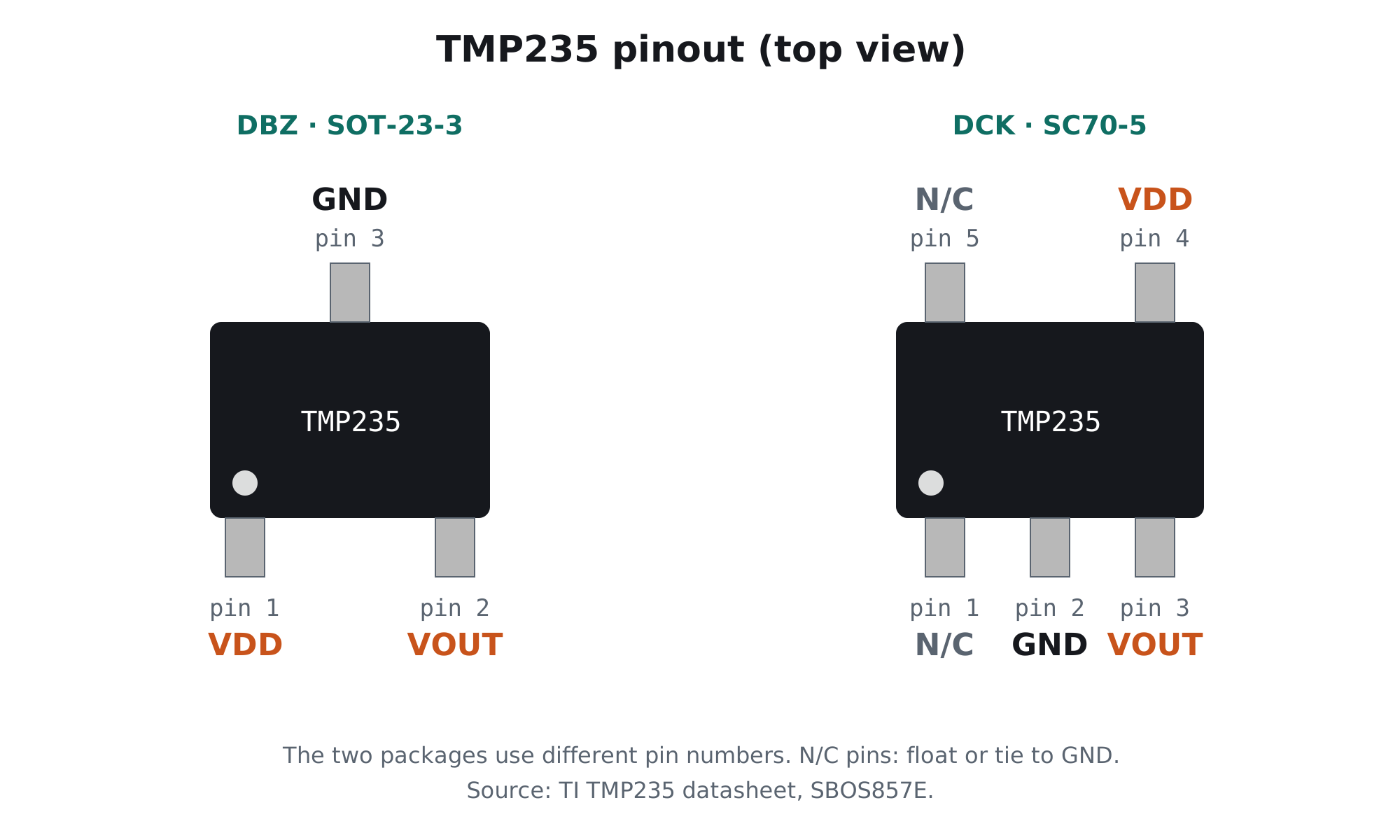
| Pin | SOT-23-3 (DBZ) | SC70-5 (DCK) |
|---|---|---|
| VDD | 1 | 4 |
| VOUT | 2 | 3 |
| GND | 3 | 2 |
| N/C | – | 1, 5 (float or tie to GND) |
TMP235 typical application circuit
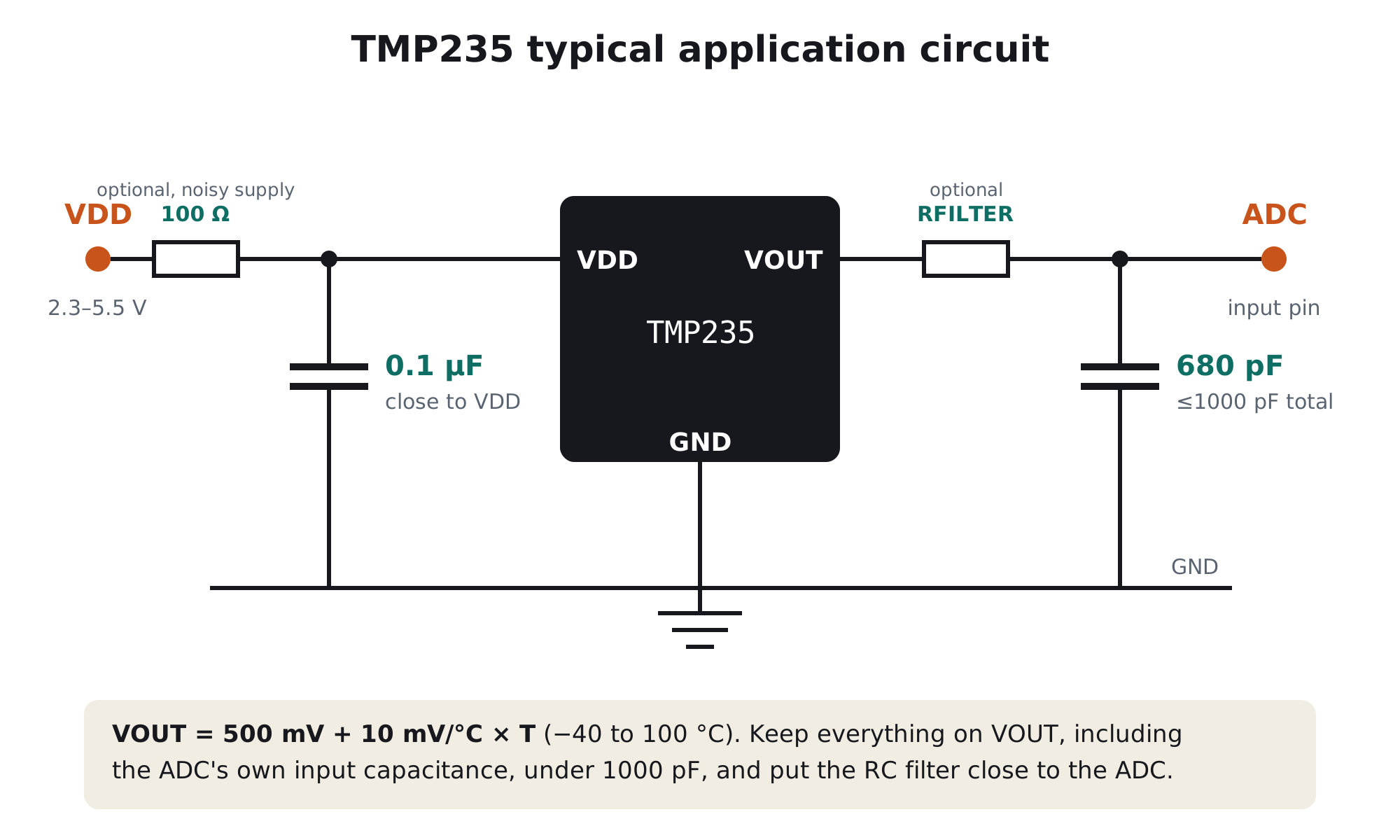
- 0.1 µF on VDDRight at the pin. On a noisy supply, TI suggests adding 100 Ω in series with VDD to form a small filter.
- Keep the output’s load smallThe TMP235 is stable with up to 1000 pF on its output, and that budget includes your ADC’s own input capacitance. TI suggests about 680 pF as a filter capacitor, placed at the ADC pin. A big “smoothing” capacitor here can make it oscillate.
- Mount it to what you measureThe sensor reads its own die temperature, which follows whatever its pins and pad are bonded to. Good thermal contact matters more than anything else (see our measured response test below).
TMP235 formula and code
From −40 to 100 °C the transfer function is a straight line: VOUT = 500 mV + 10 mV/°C × T, so T = (VOUT_mV − 500) ÷ 10. 25 °C reads 750 mV; 100 °C reads 1.5 V. Above 100 °C the slope rises slightly (10.1 then 10.6 mV/°C), and TI gives a piecewise formula if you need that range.
// ESP32 (Arduino core): GPIO34 is an ADC1 pin, safe with Wi-Fi on
float readTMP235() {
  long sum = 0;
  for (int i = 0; i < 32; i++) sum += analogReadMilliVolts(34);
  float mv = sum / 32.0;
  return (mv - 500.0) / 10.0;      // degrees C, valid -40 to 100 C
}

// Arduino Uno with a 3.3 V reference on AREF (call analogReference(EXTERNAL) first)
float readTMP235_uno() {
  float mv = analogRead(A0) * 3300.0 / 1023.0;
  return (mv - 500.0) / 10.0;
}
Because it uses the same 500 mV offset and 10 mV/°C as the TMP36, code written for a TMP36 works unchanged. On an ESP32 at the default attenuation, the ADC’s recommended range is roughly 0.15 to 2.45 V, which covers the TMP235 from about −35 to 150 °C (0.15 to about 2.02 V).
TMP235 vs LM35
| TMP235 | LM35 | |
|---|---|---|
| Supply | 2.3 to 5.5 V (works on 3.3 V) | 4 to 30 V (not 3.3 V) |
| Output at 0 °C | 500 mV: reads below 0 °C on one supply | 0 V: needs a negative supply below 0 °C |
| Scale | 10 mV/°C | 10 mV/°C |
| Supply current | 9 µA | About 60 µA |
| Range | −40 to 150 °C | −55 to 150 °C (with negative supply) |
| Package | SMD (SOT-23, SC70) | TO-92 through-hole available |
For a new 3.3 V or battery design, the TMP235 is the easier part. Moving from an LM35 means one code change: subtract 500 mV before dividing by 10.
Skip the SMD soldering
SwiftSense T235: the TMP235 on a fast-response module
The LM35 alternative that runs on 3.3 V, on an aluminium board that follows temperature changes quickly.
- Genuine TI TMP235, A2 accuracy grade
- Aluminium MCPCB: about 2× faster response than FR4 in our test
- Murata ferrite filtering, M3 mounting hole
- Designed & made in Pune, India
For engineers: the finer print
1. Read the accuracy table carefully
The ±0.5 °C headline is typical. The guaranteed A2 limits are ±1 °C (SC70) or ±1.2 °C (SOT-23) from 0 to 70 °C, and ±2 °C over −40 to 150 °C. A one-point calibration at room temperature removes most of the offset if you need better.
2. Your ADC sets the real resolution
One °C is 10 mV. A 10-bit ADC on a 3.3 V reference resolves about 3.2 mV (0.3 °C), and reference noise turns straight into reading noise. Give the ADC a clean reference; our analogRead fluctuating guide shows how.
3. Self-heating is negligible
At 9 µA from 3.3 V the sensor dissipates about 30 µW. Even at the SC70’s 275 °C/W, that’s under 0.01 °C of self-heating.
Frequently asked questions
What is the TMP235?
The TMP235 is an analog temperature sensor from Texas Instruments with a 10 mV/°C output and a 500 mV offset at 0 °C. It runs from 2.3 to 5.5 V, draws 9 µA, measures −40 to 150 °C, and the A2 grade is ±0.5 °C typical from 0 to 70 °C.
What is the TMP235 pinout?
In SOT-23-3 (DBZ): pin 1 VDD, pin 2 VOUT, pin 3 GND. In SC70-5 (DCK): pin 1 no connection, pin 2 GND, pin 3 VOUT, pin 4 VDD, pin 5 no connection.
How do I convert TMP235 voltage to temperature?
Subtract 500 mV and divide by 10 mV/°C: T (°C) = (VOUT in mV − 500) ÷ 10. For example, 750 mV is 25 °C. This is exact from −40 to 100 °C; above 100 °C TI gives a slightly different slope.
Is the TMP235 a good LM35 alternative?
Yes, especially on 3.3 V boards. The TMP235 works from 2.3 V, reads below 0 °C on a single supply thanks to its 500 mV offset and uses about 9 µA. The LM35 needs at least 4 V and a negative supply to read below 0 °C.
Can I use the TMP235 with an ESP32?
Yes. Power it from 3.3 V, connect VOUT to an ADC1 pin such as GPIO34 and use analogReadMilliVolts(). Its output stays below about 2.02 V even at 150 °C, inside the ESP32 ADC’s recommended range for temperatures above about −35 °C.
What is the difference between TMP235 and TMP236?
The TMP236 has a higher gain of 19.5 mV/°C with a 400 mV offset and needs at least 3.1 V; its electrical specs cover −10 to 125 °C. The TMP235 has 10 mV/°C, a 500 mV offset and works from 2.3 V.
Build with it today
The LM35 upgrade for 3.3 V boards
Genuine TMP235 on an aluminium, fast-response module. Made in India.