Datasheet explained · Texas Instruments · TMP63 linear thermistor
TMP6331 Datasheet Explained: Linear PTC Thermistor Specs, Pinout & Circuit
The TMP6331 datasheet describes a thermistor that behaves very differently from the NTC you know: it’s linear, it’s made of silicon, and it has a polarity. Here’s everything you need to use it, checked against TI’s datasheet.
Ramanu Systems · Pune, India · Based on TI TMP63 datasheet SNIS211D
The TMP6331 is a 100 kΩ linear silicon PTC thermistor from Texas Instruments, part of the TMP63 family. Its resistance rises with temperature, by about 0.64% per °C at room temperature, and far more evenly than an NTC’s. Put it in a voltage divider with a 100 kΩ resistor and read the midpoint with any ADC.
Is the TMP6331 right for your design?
It’s a good fit if:
- You use NTC thermistors today and hate the curve-fitting
- You need consistent accuracy at high temperatures (to 150 °C)
- You want low bias current and low self-heating
- You want a part that fails safe if shorted to the supply
- You’re measuring motors, batteries, heaters or power stages
- You read it with any ADC: Arduino, ESP32, Pico, STM32
Look elsewhere if:
- You want a direct voltage output (use a TMP235)
- You need a digital I²C reading
- Your assembly can’t guarantee polarity
- You need below −40 °C
TMP6331 key specifications
| Parameter | Value | Condition / note |
|---|---|---|
| Resistance at 25 °C | 100 kΩ | Nominal |
| Tolerance | ±1% max | 0 to 70 °C (±1.5% over −40 to 125 °C) |
| Temperature coefficient | 6400 ppm/°C | At 25 °C (6220 at −35 °C, 5910 at 85 °C) |
| Temperature range | −40 to 150 °C | DYA package; DEC package to 125 °C |
| Sense current | 40 µA max recommended | Specs at 20 µA; 450 µA absolute max |
| Sense voltage | 5.5 V max recommended | |
| Thermal response | 0.6 s (63%) | Into stirred liquid; 3.2 s in still air |
| Long-term drift | About ±0.2 to 0.3% | After 600 to 1000 h at 150 °C |
| Recommended bias resistor | 100 kΩ | Used for TI’s resistance-temperature tables |
TMP6331 pinout and polarity
It looks like a two-terminal chip resistor, but it isn’t symmetrical. TI’s rule: connect the positive terminal (pin 2) to the higher voltage.
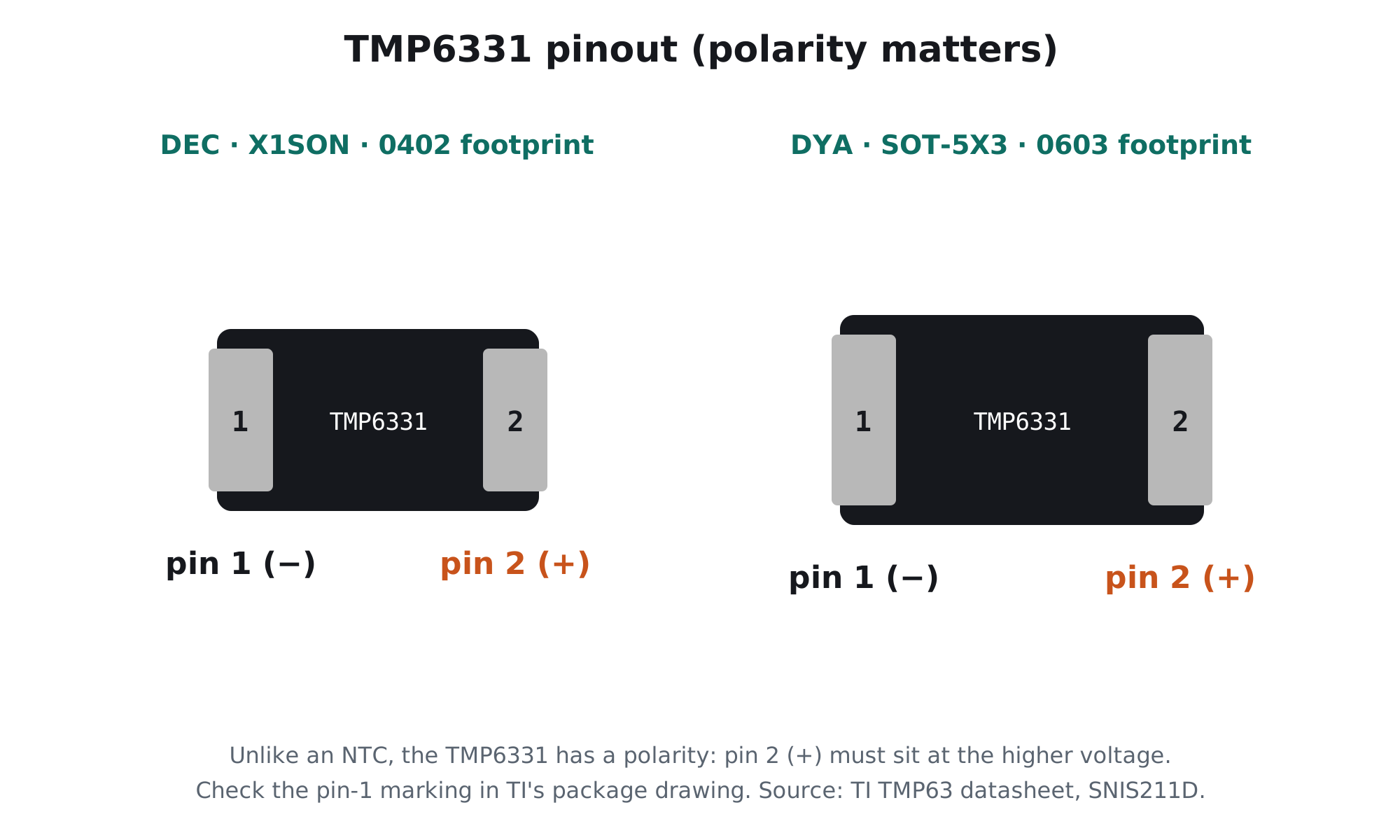
| Package | Footprint | Body | Range |
|---|---|---|---|
| DEC (X1SON-2) | 0402-compatible | 0.60 × 1.00 mm | −40 to 125 °C |
| DYA (SOT-5X3) | 0603-compatible | 0.80 × 1.20 mm | −40 to 150 °C |
TMP6331 typical circuit: the ratiometric divider
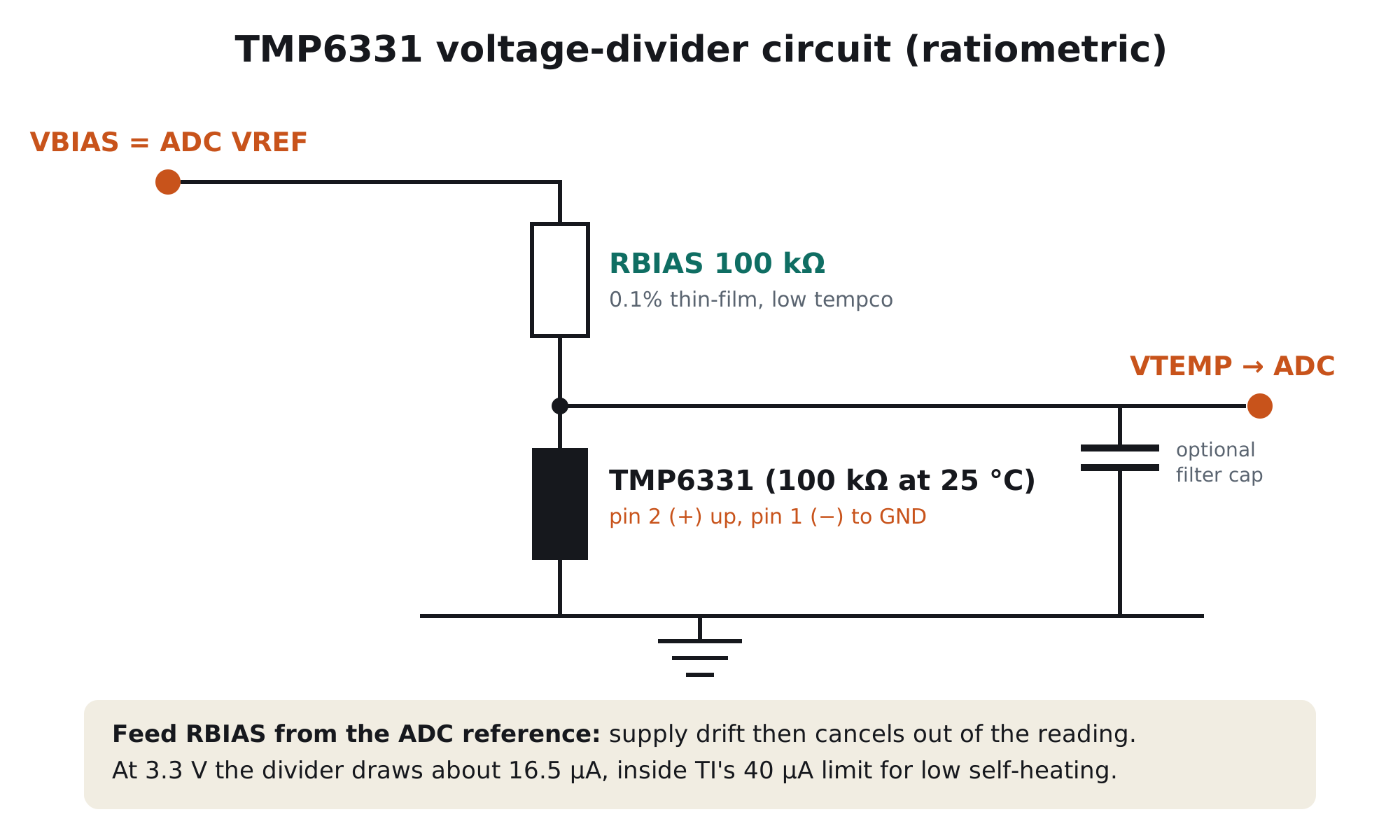
- 100 kΩ bias resistor on topUse a precise, low-tempco resistor (0.1% thin film is ideal). TI’s resistance-temperature tables assume 100 kΩ; change it and you must regenerate the table.
- Feed it from the ADC referenceConnect the top of the divider to the same voltage the ADC uses as its reference. Then the supply cancels out of the reading:
code = R_TMP ÷ (R_BIAS + R_TMP) × full scale, whatever the exact supply is. - Mind the polarity and currentWith the TMP6331 at the bottom, pin 2 (+) goes to the divider midpoint and pin 1 (−) to GND. At 3.3 V the divider draws about 16.5 µA, well under TI’s 40 µA limit.
Reading it in code
// Arduino: TMP6331 low side, 100k bias from the ADC reference (5 V or 3.3 V)
const float R_BIAS = 100000.0;

float tmp6331Ohms(int pin) {
  long sum = 0;
  for (int i = 0; i < 16; i++) sum += analogRead(pin);
  float a = sum / 16.0;                 // 0..1023
  return R_BIAS * a / (1023.0 - a);     // ratiometric: supply cancels out
}

// Quick estimate near room temperature (first-order, 6400 ppm/C at 25 C).
// For the full range, use the polynomial or look-up table from
// TI's Thermistor Design Tool.
float tmp6331CelsiusApprox(float ohms) {
  return 25.0 + (ohms / 100000.0 - 1.0) / 0.0064;
}
The midpoint moves by about 5.3 mV per °C at 3.3 V around room temperature, so a 10-bit ADC resolves roughly 0.6 °C and a 12-bit one about 0.15 °C.
TMP6331 vs an NTC thermistor
| TMP6331 (linear PTC) | Typical NTC | |
|---|---|---|
| Resistance vs temperature | Rises, close to a straight line | Falls steeply and exponentially |
| Conversion | Short polynomial or small table | Steinhart-Hart or a large table |
| Sensitivity at high temperature | Stays useful to 150 °C | Flattens out: fewer ADC counts per °C when hot |
| Self-heating | Bias power falls as it heats | Bias current rises as it heats |
| Short to supply | Self-limiting (resistance rises) | Can run away |
| Polarity | Yes: pin 2 positive | None |
TI’s datasheet makes these points: no linearisation circuit, no mid-point calibration, tighter tolerance at high temperatures and simpler processor maths.
Skip the 0603 soldering
RS-TMP6331-100K: the TMP6331 on a ready module
A linear silicon PTC on an aluminium board, with the precision bias resistor already fitted.
- Genuine TI TMP6331 with a 100 kΩ ±0.5% bias resistor
- Ratiometric output: supply drift cancels
- Only 16.5 µA at 3.3 V, −40 to +150 °C
- Aluminium MCPCB, M3 screw mount, Arduino sample code
- Designed & made in Pune, India
For engineers: the finer print
1. Self-heating is tiny, but know your package
At 3.3 V and 25 °C, the thermistor dissipates about 27 µW. With the DYA package’s 742.9 °C/W (443.4 °C/W for DEC), that’s about 0.02 °C of self-heating. It grows with the square of the bias current, which is why TI caps it at 40 µA.
2. Best accuracy needs a current source
The divider is simple and ratiometric. For the highest accuracy, TI notes that driving the TMP63 with a precision current source (up to 40 µA) gives an output that is directly proportional to resistance, with gain up to about 40 mV/°C.
3. The coefficient changes slightly with temperature
6400 ppm/°C at 25 °C falls to 5910 ppm/°C at 85 °C. A single straight line is fine near room temperature; across the full range, use the polynomial or table from TI’s Thermistor Design Tool.
Frequently asked questions
What is the TMP6331?
The TMP6331 is a 100 kΩ linear silicon PTC thermistor from Texas Instruments, part of the TMP63 family. Its resistance rises with temperature at about 6400 ppm/°C at 25 °C, with ±1% tolerance from 0 to 70 °C and a range up to 150 °C in the DYA package.
Does the TMP6331 have a polarity?
Yes. Unlike an NTC thermistor, the TMP6331 must be connected with its positive terminal, pin 2, at the higher voltage and pin 1 toward ground.
What bias resistor should I use with the TMP6331?
TI recommends a 100 kΩ bias resistor in a voltage divider, ideally a precise, low-temperature-coefficient part, fed from the ADC reference voltage so supply variations cancel out.
How do I convert TMP6331 resistance to temperature?
Compute the resistance from the divider (R = R_BIAS × code ÷ (full scale − code)), then use the polynomial or look-up table generated by TI’s Thermistor Design Tool. Near room temperature, T ≈ 25 + (R ÷ 100 kΩ − 1) ÷ 0.0064 is a quick estimate.
Is a TMP6331 better than an NTC thermistor?
For most microcontroller projects it is easier: its response is nearly linear, so conversion needs less code, its tolerance stays tighter at high temperatures, and its self-heating falls as it warms. An NTC is still cheaper and has no polarity.
What is the maximum current for the TMP6331?
TI recommends at most 40 µA of sense current and 5.5 V across the sensor; the absolute maximum is 450 µA. A 100 kΩ divider at 3.3 V draws about 16.5 µA.
Build with it today
A linear thermistor, ready to screw down
Genuine TMP6331 with its precision bias resistor on an aluminium board. Made in India.